
5 Ultherapy Side Effects, Is it Really Safe? A Dermatologist Answers
Ultherapy side effects can be broadly classified into five categories: burns, pigmentation, fat atrophy, blood vessel damage, and nerve damage, with an incidence rate of less than 1-2%. Most of these are temporary, but in cases like fat atrophy, natural recovery can be difficult, making a consultation with a specialist essential before the procedure. This article was personally written by a dermatologist with experience as a fellow at Hanyang University, for the purpose of providing medical information.
Hello. This is Kim Young-gyun, CEO and Director of Core Dermatology.
Before Ultherapy, you might have had these worries, right?
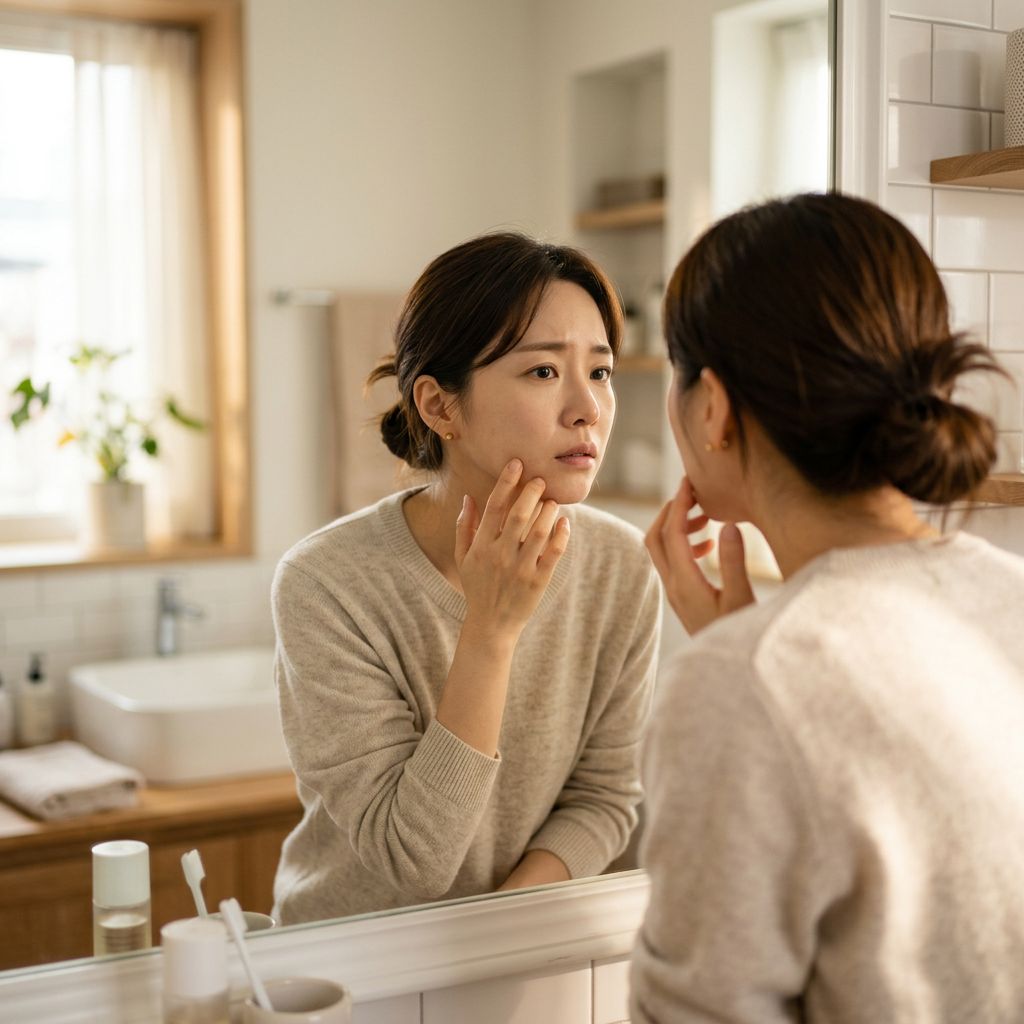
I saw a review saying they got burned. Is it okay? Some people said their face caved in after the procedure. Is it true that bruising lasts a long time?
Among those who come for consultations at our Core Dermatology Clinic, Six to seven out of ten people already search for “Ultherapy side effects.”.
So when I start a consultation, I first say something like this.
“What you saw on the internet isn't entirely wrong. It's just missing context.”
Today, I'm here to fill in that context.
I will tell you the facts about Ultherapy side effects, without any embellishment or omission.
Not a vague fear What can actually happen, why it happens, and how to prevent itI'll organize it all for you at once.
Before we talk about Ultherapy side effects, let's understand how Ultherapy works.
Before talking about Ultherapy side effects, you need to understand its principles first.
Because You need to know where the energy is going to understand why problems can arise there.
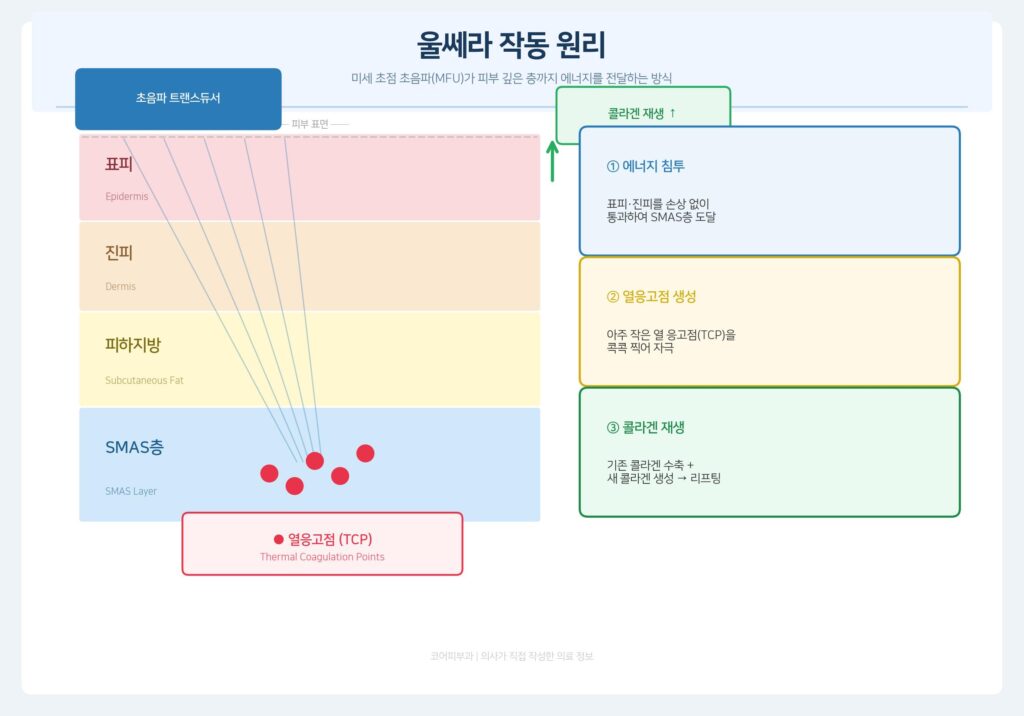
Ultherapy Micro-focused Ultrasound uses energy. This energy penetrates deep into the skin, especially SMAS (Superficial Musculoaponeurotic System) reaching a layer called up and creating very small thermal coagulation points, TCP in English.
That's a difficult word, isn't it?
To put it simply, it's like this.
This involves making very fine ‘dots" deep within the skin. With that stimulation, existing collagen contracts, and new collagen is simultaneously produced, naturally leading to a lifting effect.
Now that you understand the principles, let's get into the side effects.
Let's look at the actual probability of Ulthera side effects first.
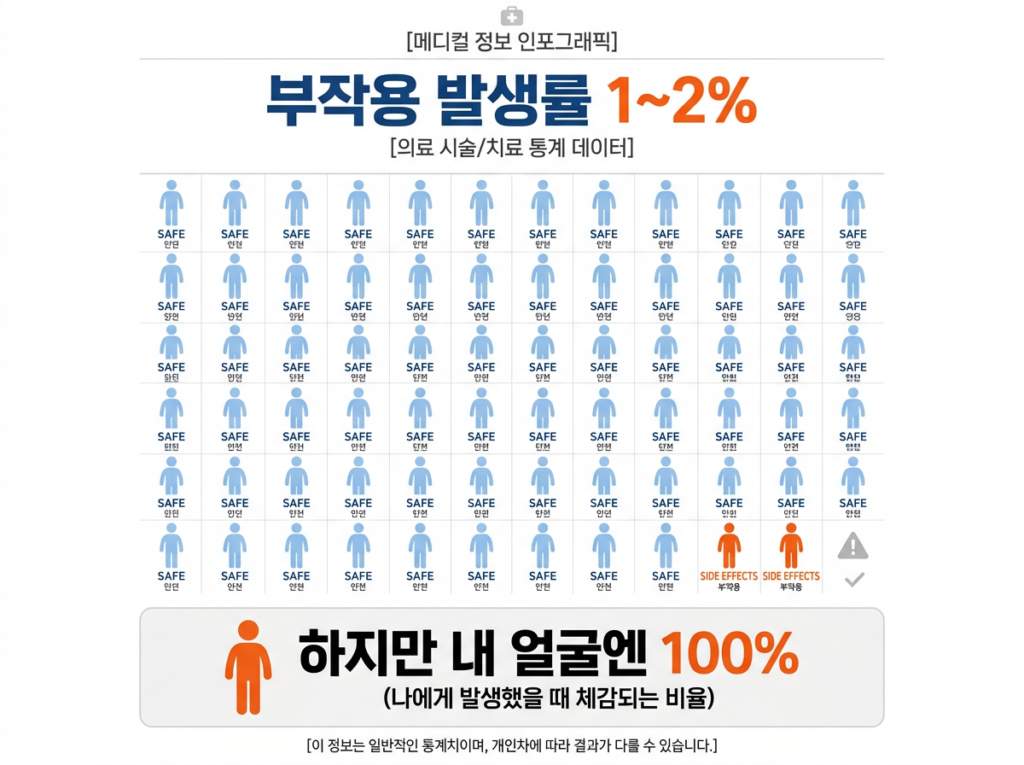
Regarding the numbers, the probability of experiencing side effects after Ultherapy treatment is 1-2% or lessis being reported.
The majority of Ultherapy treatments are completed safely. And even if side effects occur, most of them TemporaryIt will heal naturally over time.
But there's something I always tell my patients.
“1-2%seems low, doesn't it? But if it appears on my face, it's 100%.”
So, what's more important than probability is ‘prevention," and the key to prevention lies in the technician's technique.
I'll explain them one by one below.
1. Burns, blisters, hives (welts)
This is what most people worry about.
If thermal damage occurs due to ultrasonic energy Superficial and Dermal Burns, Blister, Wheal (hive-like swelling) can appear as.
Why does this heat damage occur?.
most Problem with the procedure techniqueIt's because too much energy was applied, the transducer (ultrasound tip) angle was incorrect, or not enough coupling gel was used. These technical factors are the main causes.
However, the situations actually encountered in the examination room are a bit more complex.
There are cases where people who are sensitive to pain are startled during a procedure and suddenly turn their heads. At that moment, the transducer contact surface can become misaligned, concentrating the energy in one spot. Therefore, Before any procedure, I always check pain sensitivity and, if necessary, allow ample time for the anesthetic cream to take effect. This small difference is bigger than you think.
Welt vs. burn, what's the difference?
WeltThis is a relatively mild reaction. It tends to occur quite frequently.
Especially 1.5mm transducer(Tip for shallow depth) When performing procedures, it often occurs on thin skin areas like the neck. However, usually Recover cleanly without long-term sequelaeIt works.
Burns and blistersThat's a different story. It's rare, but once it happens, 1-2 weeks recovery periodand is necessary, even after healing Post-inflammatory hyperpigmentation (PIH) or scarringmay remain.
For treatment: In case of welts, cooling and topical steroids can reduce inflammation. For burns or blisters, wound management, antibiotics to prevent secondary infections, and possibly laser treatment for pigmentation or scars may be necessary.
In the end Apply plenty of coupling gel, maintain the correct angle, and set the energy level according to the patient's skin thickness. This is the most basic of basics, but if you don't get this basic down, problems will arise.
2. Hyperpigmentation
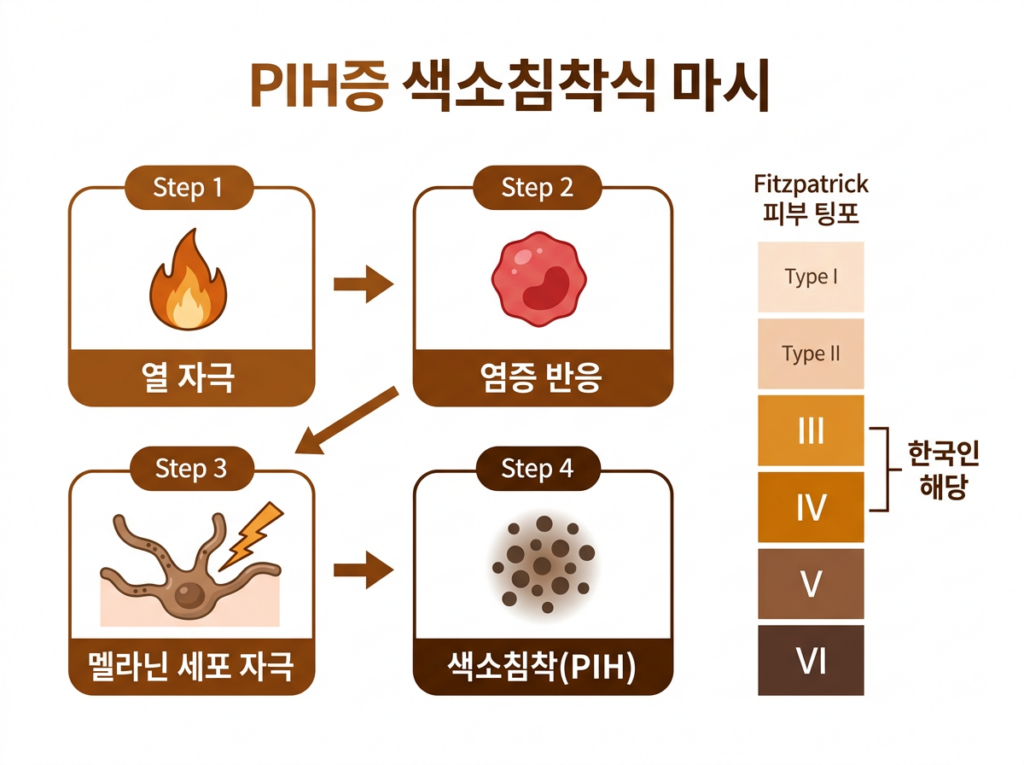
For areas where thermal damage occurred after Ultherapy treatment, Post-Inflammatory Hyperpigmentation (PIH) This may appear.
Especially People with darker skin, To be more precise, the risk increases the higher your Fitzpatrick skin type.
The mechanism is as follows.
Heat damage → Inflammatory response → Melanocyte stimulation → Excessive melanin production. That's why the affected area turns dark.
I can't help but talk about the Korean story here.
Most Koreans fall into Fitzpatrick types III-IV. Compared to Westerners with skin types I-II, melanocytes are much more reactive, so even with the same amount of thermal stimulation, PIH can appear more easily and more intensely.
What this means is that if you apply energy protocols developed in the West directly to Koreans, the risk of hyperpigmentation, one of Ultherapy's side effects, increases.
So when I treat Korean patients, I tend to set energy more conservatively.It's not always effective to just do things forcefully.
3. Muscle atrophy and volume reduction
Ah, this part. It's the concern I hear most often during consultations.
“Director, I saw a post saying that my cheeks became sunken after getting Ultherapy.”
Some people even bring community captures.
To be honest This worry is half true and half exaggerated.There are parts that have been done.
When excessive or improperly targeted ultrasonic energy enters subcutaneous fat tissue, Muscle atrophy과 Volume lossIt's true that this can happen. It's a phenomenon where the face appears sunken after a procedure.
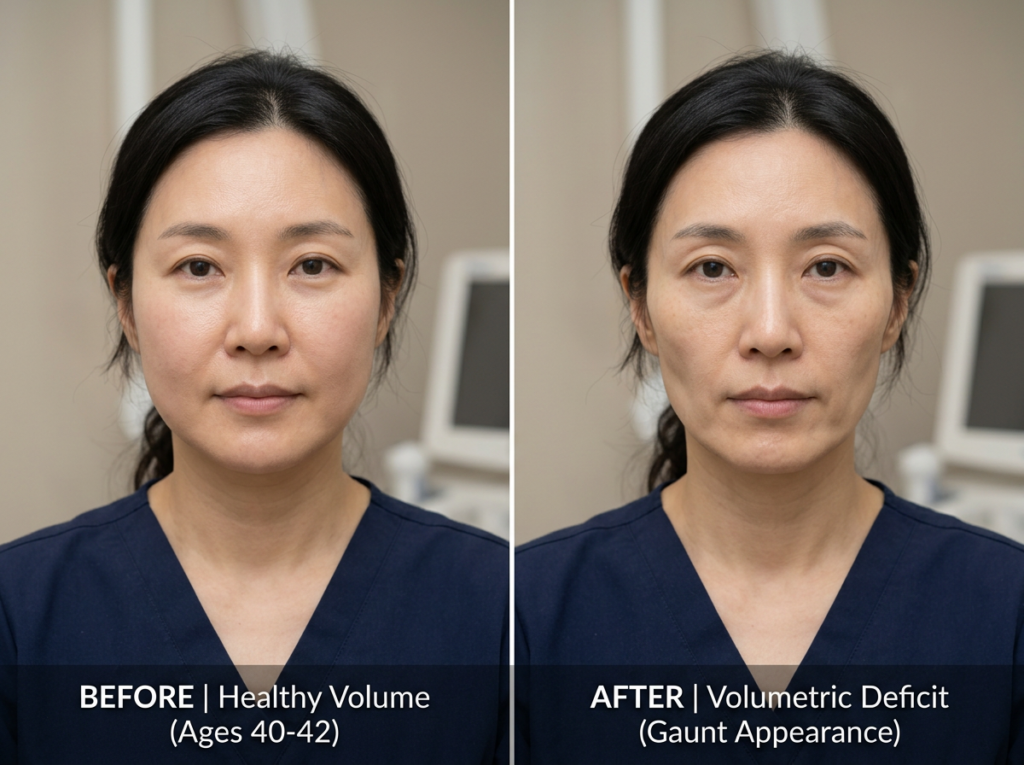
But this doesn't happen to just anyone.
People who naturally have little facial fat, This occurs when people with a thin face shape have the transducer applied in the wrong position or the depth setting is incorrect.
So prevention is key.
First, patient screening. Ultherapy is suitable for individuals with moderate to excessive facial fat. If you have very little natural fat, there's a higher risk of appearing gaunt after the procedure.
Second, depth adjustment and ultrasound visualization. You need to confirm in real-time with ultrasound imaging that the energy is accurately entering the SMAS layer or the deep dermis, and not the subcutaneous fat layer.
Third, knowing anatomically dangerous areas.
This part is quite important.
The depressions below the cheekbones (malar and submalar regions) are very vulnerable to fat loss. The temporal region already has a lack of fat, so any further loss there is very noticeable. The periorbital area (around the eyes and lower eyelids) has very thin subcutaneous tissue, making it highly susceptible to a reduction in fat pads.
What if the fat has already been lost?
Once fat is lost, it's difficult to recover naturally. This is the part that patients are most upset about among Ulthera side effects.
To restore volume, you can use hyaluronic acid fillers or biostimulator fillers like Ellanse.
What I really want to say about this part is this.
If a clinic unconditionally recommends Ultherapy for a thin face, think twice. Ultherapy isn't the right answer for everyone.
4. Blood Vessel Damage and Bruising
If ultrasonic energy affects superficial blood vessels 멍Ina HematomaThis can happen.
This depends on how well the practitioner knows the vascular anatomy of the face.
Let me briefly go over the major blood vessels.
Facial artery and facial veinIt encircles and ascends along the lower edge of the mandible, coming superficially near the anterior border of the masseter muscle. It is safe to perform the procedure superficially, lateral to this course.
Angular Artery It's a terminal branch of the facial artery that runs along the side of the nose. It's dangerous to go deep near the nasolabial fold or the medial canthus (inner corner of the eye).
Superficial temporal artery (STA) It comes out in front of the ear and goes up across the temple. This is why you shouldn't shoot energy lines along the hairline of the temple.
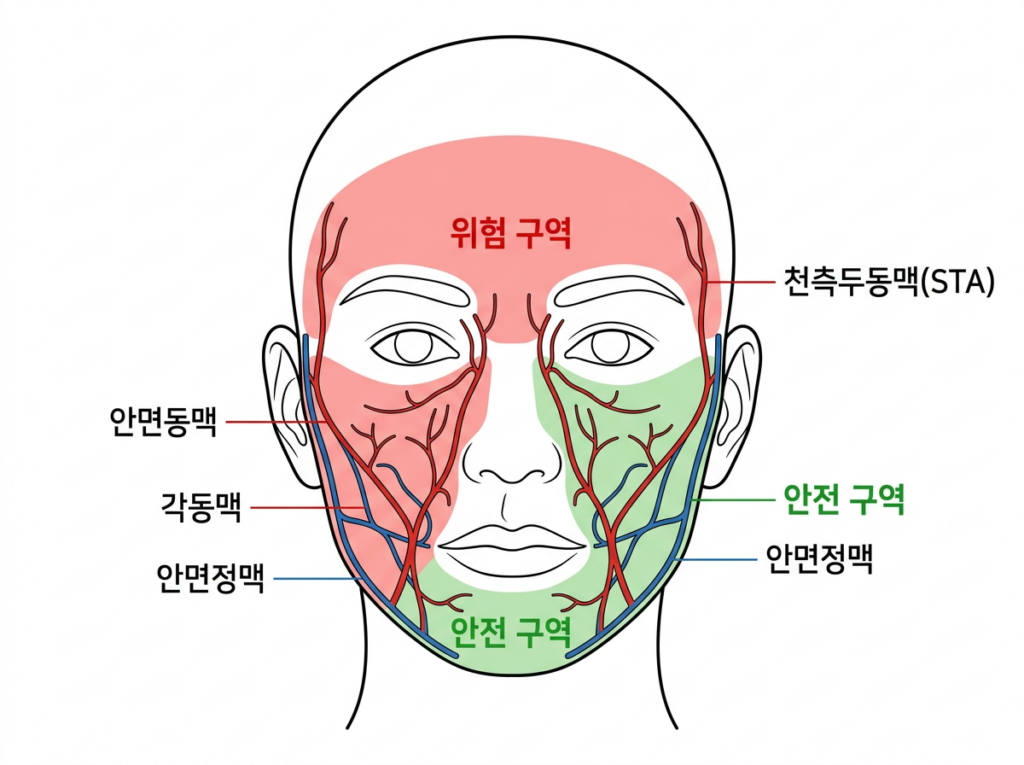
If you have a bruise, cold compresses are the basic treatment, and most bruises disappear naturally within a few weeks.
Actually, bruising is considered a minor side effect of Ultherapy. However, if you have a wedding or an important meeting, it's wise to schedule your treatment in advance.
5. Nerve Damage
I need to explain this part in more detail. This is the Ultherapy side effect that patients are most surprised by.
If Ultherapy's thermal energy affects superficial nerves Neuropathic pain(Shooting or electric-like pain) or Facial muscle weaknessmay appear.
“Suddenly my forehead won't rise.” “My mouth seems a little crooked.”
When you say things like that, it surprises the patient, but frankly, it also makes the practitioner nervous.
Let's go through the nerves that are exposed to danger one by one.
The frontal branch of the facial nerve runs along the superficial fascia above the zygomatic arch and innervates the frontal muscle. If this area is injured, it becomes difficult to raise the eyebrows.
Marginal Mandibular Nerve It runs along the lower edge of the jawbone and innervates the muscles of the lower lip. If damaged, the mouth may appear asymmetrical. Therefore, direct energy should not be applied directly above the lower jaw's edge.
Supratrochlear & Supraorbital Nerves It branches out from the supraorbital notch and is responsible for sensation in the forehead and scalp. Injury to this nerve can cause numbness or abnormal sensations in the forehead and hairline area.
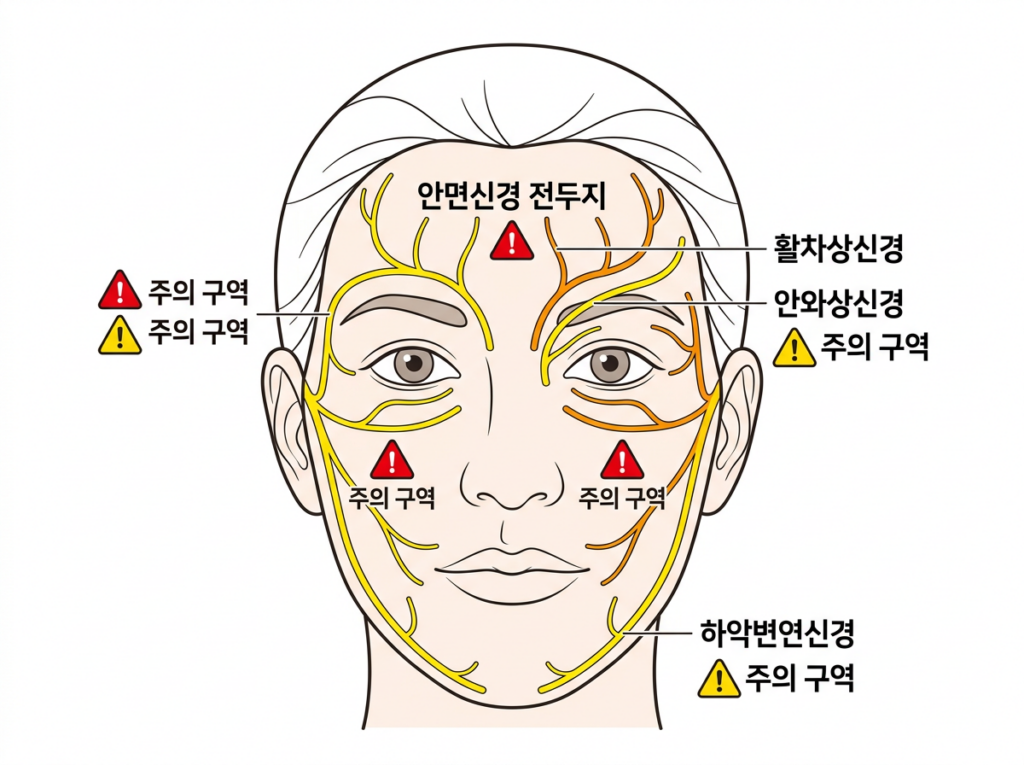
Fortunately, most nerve damage TemporaryThis means that it will likely recover naturally within a few weeks, and permanent after-effects are rare.
However, nerves are not visible on ultrasound screens because they are too small.
This is exactly why I delved deeply into ultrasound anatomy during my fellowship at Hanyang University. You need to have a mental map of where the nerves are located, even if they're not visible on the screen. It allows for a safe procedure.
People like these should not get Ultherapy.
This next part is a bit uncomfortable to talk about.
First, I am a doctor who recommends procedures, “A doctor who says, ”Don't do it to the one who shouldn't do it."I want to be.
“If you don't let us do it, won't sales decrease?” is sometimes said jokingly.
I believe that being honest and finding another way for someone who isn't a good fit, rather than having them go through hardship after being ill-suited, is true skill.
When to avoid Ultherapy:
People with very little facial fat. If you have a thin face with hollows below your cheekbones, you may appear gaunter than before the procedure due to fat atrophy.
For those with active skin inflammation. If you have severe acne, eczema, or contact dermatitis, the heat energy can worsen existing inflammation.
For those prone to keloids or scarring. If burns occur, the risk of scarring is higher than for the general public.
Pregnant and breastfeeding women. Insufficient safety data.
Areas where metal implants (such as gold threads) are embedded in the skin. These can interact with ultrasound energy and cause unexpected thermal damage.

Situations requiring careful judgment:
Individuals with autoimmune diseases (such as lupus, scleroderma, etc.), those taking anticoagulants (increased risk of bruising/bleeding), or those who have recently received fillers or Botox injections (need to coordinate treatment timing) must consult with a specialist.
The practitioner's experience is safety.
Today's post was really long, and if you've read this far, you've probably noticed one pattern.
Burn scar, pigmentation, fat atrophy, vascular damage, nerve damage.
It all comes down to the practitioner's technique and anatomical understanding.
The latest Ultherapy Prime features high-definition real-time ultrasound imaging, faster treatment speed, and reduced pain, contributing to fewer Ultherapy side effects compared to previous versions.
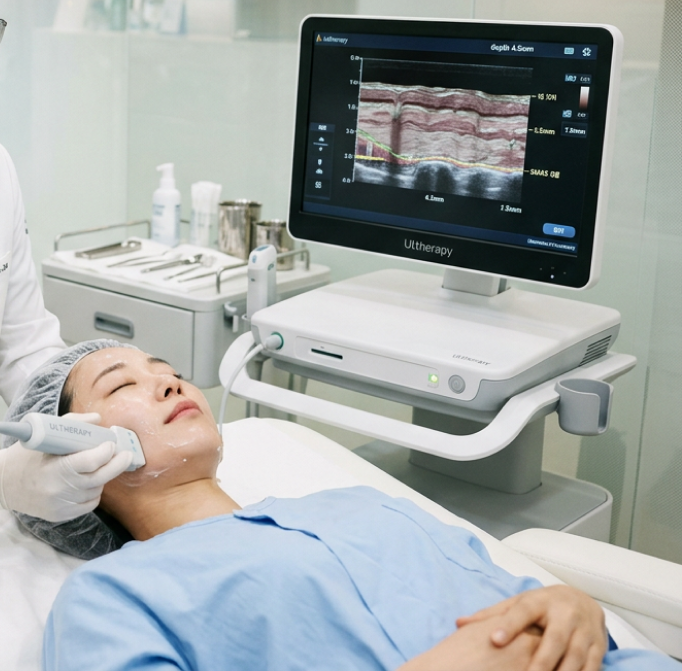
However, no matter how good the equipment gets, the hands of the person operating it ultimately determine the outcome.
If you're considering Ultherapy, rather than ‘what equipment it is" ‘Who performs the procedure, and what experience do they have?’ First, consider.
Ultherapy Side Effects FAQ
Today's three-line summary
- The incidence of Ultherapy side effects is less than 1-2%. Although most are temporary, some, like fat atrophy, are difficult to recover from, so thorough consultation before the procedure is essential.
- Burns, hyperpigmentation, fat atrophy, vascular damage, nerve damage. The 5 major side effects depend on the practitioner's technique and anatomical understanding, and Koreans need to be particularly careful about pigmentation and fat atrophy.
- People are more important than equipment. You should see an experienced dermatologist.
If you have any further questions, feel free to leave them. I will answer them when I have a moment between appointments.
“I believe that treating my patients” faces with the same care as my own is the surest way to prevent Ultherapy side effects."
Thank you.
Sincerely, Dr. Kim Young-gyun, Chief Director of Core Dermatology
This post is Based on overseas professional dataThis was reviewed and enhanced with clinical experience by Dr. Kim Young-kyun of Core Dermatology.


 한국어
한국어  English
  日本語
日本語  简体中文
简体中文