
Apgujeong Ruituo: You won't regret it if you know these 5 things before getting it.

“Director, I've tried both Rejuran and Juvelook, but honestly, I don't feel like anything has changed. I heard that Rituo in Apgujeong is really different, though. But I'm a little scared because it's extracted from human skin...”
— Actual patient, late 30s, office worker (name withheld)
✅ Conclusion first
At Apgujeong Reeto, even with the same skin booster, the duration of the effect can range from 6 months to over a year depending on ‘who injects it, at what depth, and how much.’ However, most people receive the procedure without knowing the key variables that create this difference.
Hello. This is Kim Young-gyun, CEO and Director of Core Dermatology.
Some people experienced good results with Apgujeong Lituo, while others didn't feel much difference, even though they received the same procedure with the same product. What was the difference? The Lituo reviews flooding the internet are missing something crucial. At the end of this post, I'll reveal one key checkpoint that will keep you from being swayed, no matter which dermatology clinic you consult with. Today, I'll summarize the 5 essential things that those considering the Apgujeong Lituo procedure must know.
How is Apgujeong Reetu-O different from existing skin boosters?
To put it plainly, A.
There is a question I hear most often in the examination room.
“Isn't that similar to Rejuran?”
To be honest, they are completely different.
Skin boosters can be broadly classified into four main categories. These are hyaluronic acid (focused on hydration), polynucleotides (PN, stimulating cell regeneration), collagen stimulators (PDLLA, PCL, etc.), and collagen-containing agents (ECM boosters) which include Lituo.
Rejuran is a PN ingredient extracted from salmon that signals skin cells to “create new collagen.” To put it simply, it's like sending a “blueprint” to a construction site. Reference: Rejuran Official
Apgujeong Ritou is completely different in terms of approach.
Cells are removed from human dermal tissue, and the remaining scaffold, essentially the core structure of the skin (extracellular matrix, ECM), is made into a fine powder and directly injected into the dermis. Instead of sending a blueprint, we are delivering the bricks and rebar themselves.
성분 구성을 보면 이 차이가 더 명확해집니다. 콜라겐이 89%, 피부 탄력을 담당하는 엘라스틴이 3%, 수분을 잡아두는 히알루론산 등 GAGs가 0.4%, 나머지 7.6%가 피브로넥틴·프로테오글리칸 같은 진피 구조 단백질입니다. Reference: Ozhean Zoey Re20 ECM Skin Booster
There's one thing to point out here.
“Is it safe if it's extracted from human skin?”
The acellularAllogeneic Dermal Matrix (hADM), the main ingredient in Rituo, is a medical material originally used for skin reconstruction in burn patients. It is managed. Reference: Official website of the Ministry of Food and Drug Safety
💬 Dr. Kim Young-gyun:
“We often see patients in our clinic who felt RiJuran wasn't very effective even after multiple sessions, switching to Rejuran Healer in Apgujeong. However, this isn't to say RiJuran is bad; it's just that their mechanisms of action are different. For those whose skin's ‘ability to produce its own benefits in response to stimulation” has weakened, the Rejuran Healer method of direct replenishment can lead to faster perceived results."
One-line summary: Rejuran signals the skin to “create,” while Apgujeong Rituo directly fills in the skin's structural components—fundamentally different approaches.
When can you feel the effects of Apgujeong Litto?
In my experience, most people who receive the treatment at Apgujeong Lito begin to feel “Oh, something's different” about two weeks after the procedure, rather than immediately after.
This is important because.
Hyaluronic acid boosters noticeably increase hydration the day after the procedure. You see that dewy glow immediately. So, some people who undergo the procedure at Rithuo in Apgujeong might become anxious, thinking, “Did I just waste my money?” if they don't see any changes after two or three days.
But that's normal.
Lutou doesn't pull moisture in the way hyaluronic acid does. It takes time for the ECM components injected into the dermis to settle, activate surrounding fibroblasts, and generate new collagen and elastin. Reference: Vogue Singapore Elravie Re2O
Here's a summary of the perceived effect timeline.
The first week after the procedure is when the micro-bumps and slight swelling at the injection site subside. During this time, it is difficult to expect noticeable changes.
Many people say their skin texture becomes smoother from the 2nd to 3rd week, and they can feel a difference with their fingertips when washing their face. Increased hydration also starts around this time.
Weeks 4-8 are the main period of change. You'll notice a feeling of pores tightening, a difference in elasticity in your cheeks, and improved makeup adherence. Based on the manufacturer's clinical data, improvements of 11.3% in skin texture density%and 12.7% in skin roughness% have been reported, and patient satisfaction is highest during this time in actual clinical practice. Reference: Ozhean Zoey Re20 ECM Skin Booster
To add one more thing, the timing of the procedure is also more important than you might think.
In Korea, dryness and fine dust worsen during every seasonal transition, don't they? It takes about two weeks for the skin barrier to stabilize after receiving Lituo treatment, and if external stimuli are severe during this period, it can affect recovery. If possible, we recommend starting the treatment when the season is more stable, rather than right before the spring and autumn transitions.

💬 Dr. Kim Young-gyun:
“I recall a client, Ms. A, a professional in her late thirties. She had undergone three sessions of Rejuran but felt there was minimal change in her pores, so she switched to Rituo in Apgujeong. For the first two weeks, she again said, ‘There's no real difference.‘ However, about a month later, she mentioned that a colleague at work asked her, ”What did you do to your skin?" This is characteristic of Rituo's effects. It's gradual, but definite.”
One-line summary: The effects of Apgujeong Rituo can be felt starting two weeks after the procedure, and improvements in pores, elasticity, and skin texture can become more apparent over the course of four to eight weeks.
How long does the effect of Aptos threads last?
To be honest, there are clinical reports stating that based on a single session, it lasts for about 6 months, and with repeat sessions, it can be maintained for over a year.
“How long does it last after one dose?”
Everyone asks this question in the doctor's office.
I'll get straight to the conclusion.
When you receive one treatment of Apgujeong Rejuran, the effects typically last for about 4-6 months. This is considerably longer compared to existing hyaluronic acid skin boosters, which last for about 2-3 months. There's a reason for this. While hyaluronic acid is absorbed by the body and disappears over time, the ECM components infused with Rejuran reinforce the dermal structure and simultaneously induce new collagen synthesis. It's not simply that something “filled in” is leaving; the collagen that the skin creates on its own lasts for a longer period. Reference: Dr. Daniel Chang ECM Skinbooster Guide
But the important thing here is the difference in repeated procedures.
There are reports that repeating the procedure 2-3 times at 3-4 week intervals can lead to cumulative effects and last for over a year. Think of it like putting money into a savings account at a bank; it's a concept of building up collagen assets in the dermis. Overseas, this is called “collagen banking.”. Reference: The Aesthetic Studio Singapore
However, there is something I need to tell you honestly.
The duration of results varies greatly from person to person. Age, skin thickness, sun exposure, smoking status, and even sleep habits all have an impact. It's difficult for someone in their late twenties and someone in their mid-forties to expect the same results, and even for people of the same age, it will differ depending on their skin's condition. If you set your expectations too high based solely on the statement “it lasts for a year,” you might be disappointed.
Here's a summary of the recommended protocol: initially, undergo 2-3 sessions every 3-4 weeks, followed by maintenance sessions every 6-12 months.
💬 Dr. Kim Young-gyun:
“In my experience, it's rare for people to say ‘Wow, amazing’ after just the first treatment. After the second treatment, people definitely feel a difference, and after the third treatment, it's common for others to notice. Instead of expecting a big effect all at once, you'll be much more satisfied if you plan for two to three treatments from the start.”
One-line summary: Apgujeong Lituo's maintenance period is approximately 6 months for a single session. For 2-3 repeat sessions, it lasts over 1 year. However, since individual results vary, it is realistic to plan for repeat sessions from the beginning.
Could there be side effects from Liguro, such as nodules?
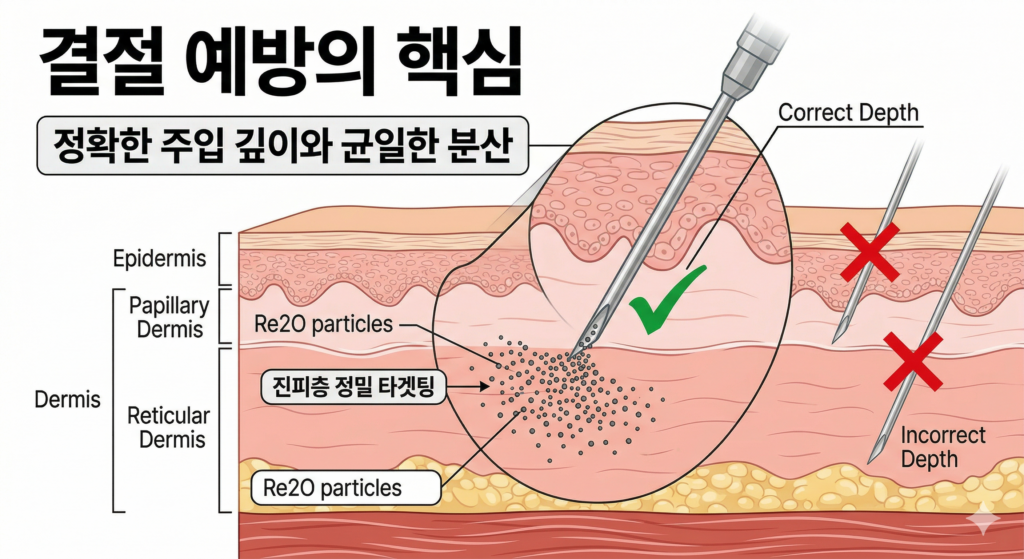
To get straight to the point, there is a possibility of nodule formation. However, by precisely controlling the injection depth and dosage, the probability of occurrence can be significantly reduced, and in mild cases, they are absorbed naturally within a few weeks.
“Apgujeong Lietuo nodule” - If you search for it on Naver, you'll find quite a few related articles. It's also the part that worries people considering the procedure the most.
I will not hide it. There is a possibility of a nodule.
Rejuran is a procedure that injects ECM components in a fine powder form. If these powder particles do not spread evenly within the skin and clump together in one spot, nodules that feel like small granules can form on the skin's surface. The average particle size of existing Rejuran is 100㎛, and this can cause problems if it is excessively deposited in shallow layers. Reference: Hankyung.com - Ritoo Fine Launch
Then why do nodules form?
The cause is almost always in the injection technique. The probability of occurrence increases if it's injected too shallowly, too much volume is concentrated in one area, or there isn't enough post-injection dispersion. It's much more often an issue with the practitioner's injection design rather than a problem with the product itself.
When there's a minor nodule.
They are naturally absorbed and disappear within 2 to 4 weeks in most cases. In fact, a dermatologist once publicly shared a case where nodules occurred after a procedure on themselves at Apgujeong Lituo, but they naturally disappeared after about a month. Of course, in rare cases, they may persist for a long time, so if you feel any abnormalities after the procedure, you must revisit the clinic where you received the treatment.
In addition to nodules, I will also summarize common side effects.
Small bumps (embossing) may appear at the injection site immediately after the procedure. While many reviews mention less embossing compared to Rejuran, it's not completely absent. Mild redness, swelling, and pinpoint bleeding (bruising) may also occur, but these usually subside within 24-48 hours. The downtime is such that makeup is possible the next day. Reference: Vogue Singapore Elravie Re2O
We also inform you about contraindications. Pregnant and breastfeeding women, those with active infections at the treatment site, and individuals with a history of severe allergies should avoid the procedure. Reference: Dr. Daniel Chang ECM Skinbooster Guide
💬 Dr. Kim Young-gyun:
“There are some people who give up on Lituo in Apgujeong because they're afraid of nodules. But to be honest, nodules are formed when the injection is done incorrectly, not due to an inherent problem with the Lituo product itself. The key is to inject it at the appropriate depth, in the appropriate amount, and disperse it evenly. That's why it's important ‘who administers it”."
One-line summary: Most nodulations can be prevented with precise control of injection depth and dosage, and mild nodulations are naturally absorbed within a few weeks.
Why does ‘who injects" change the outcome?
제 경험상, 압구정 리투오는 ‘어떤 제품을 쓰느냐’보다 ‘누가, 어떻게 주입하느냐’에서 결과의 80%가 갈린다고 봐도 과언이 아닙니다.
This might sound strange. Why would the results be different for the same product?
That's true.
Lithuo is not a procedure where you inject a set amount into a specific area like a standard filler and it's finished. Each patient has a different skin thickness, a different dermal layer density, and a different degree of collagen loss. Even among those in their 30s, some have thick dermis in their cheeks but skin as thin as paper under their eyes, while others have firm foreheads but sunken nasolabial folds.
This is where the operator's ‘injection design" comes in.
At what depth should it be injected? How much should be injected at one point? Should needles be used, or cannulas, or equipment like Mirajet? The results vary completely depending on the combination. If overly large particles of traditional Rejuran are forcefully injected into the thin dermis under the eyes, the risk of nodules increases. Conversely, if too little is injected into the thick dermis of the cheeks, the perceived effect decreases.
Re2O Fine, launched in December 2025, is a product with a reduced average particle size from the previous 100㎛ to 50㎛. The choice of product can differ by area; for sensitive areas like the tear trough, Fine is used, while for wider areas with thicker dermis such as cheeks or jawline, the existing Re2O is used. Reference: Hankyung.com - Ritoo Fine Launch
So, ultimately, we come back to this question.
“Is the person performing the procedure a dermatologist? And do they examine my skin condition directly and explain the injection plan?”
If you ask just this one question, you'll immediately know how that hospital handles Apgujeong Rituo.
💬 Dr. Kim Young-gyun:
“At Core Dermatology, we always check skin thickness and dermal condition before performing the Rejuran treatment. Even with the same Rejuran vial, we discuss with the patient where and how much to administer before starting the procedure. In my 15 years of dermatology practice, I've realized that *how* a product is used is far more important than using a good product. This is especially true for Rejuran.‘
One-line summary: With Apgujeong Rejuvo, even with the same product, the results can vary greatly depending on injection depth, volume, and tool selection. Therefore, the proficiency of the medical staff who can accurately assess the skin condition and design the injection is crucial for treatment satisfaction.
Apgujeong Lituo FAQ
If you are considering Lituo in Apgujeong, be sure to consult about an injection design that suits your skin condition before the procedure.
Don't just choose based on reviews and price alone,
Please check the checklist we discussed today one more time.
Thank you for reading the long text.
Sincerely, Kim Young-gyun, Chief Director of Core Dermatology
Scales of justice Legal Notice
This content has been prepared in compliance with medical law. The effects of the procedure may vary depending on the individual, and side effects may occur. Please make sure to consult a specialist at a medical institution for accurate diagnosis and treatment. The clinical values and maintenance periods mentioned in this article are based on research data and manufacturer information, and do not guarantee the same results for all patients.
📚 References
- Ozhean Zoey — Re20 ECM Skin Booster in Singapore
- Dr. Daniel Chang — What Is an ECM Skinbooster
- Vogue Singapore — Revamp, regrow, and renew: The lowdown on Elravie Re2O
- The Aesthetic Studio Singapore — Re20 ECM Skin Booster
- Korea Economic Daily — L&C Bio launches Rituo Fine
- Ministry of Food and Drug Safety official website
- Rejuran official



 한국어
한국어  English
  日本語
日本語  简体中文
简体中文