
Apgujeong Juvelook: 3 things to check to ensure you get the best results
“Director, I've had three Juverook sessions in Apgujeong, but honestly, I don't really see a difference. I'm worried I just wasted my money...
But my friend said their skin texture changed after just one use. What's the difference?”
✅ Conclusion first
Even if you get the same Juveris treatment 3 times in Apgujeong, some people say “my skin has drastically changed,” while others say “well, I'm not sure.”.
The difference lies not in the product itself, but in three details: ‘injection depth, capacity, and interval,’ and this article will pinpoint those differences.
Hello. This is Kim Young-gyun, CEO and Director of Core Dermatology.
Both the person who saw good results with Apgujeong Juvelook and the person who didn't saw good results received the same product.
What was different?
The reviews for Juvelook in Apgujeong flooding the internet are missing the most important thing.
Today, I'm going to talk about that story.
After you finish reading this article, you will be able to immediately determine if a dermatology clinic correctly administers Juvelook in Apgujeong by asking just one question in the consultation room.
Today, I'll share three key checkpoints for those considering Juvelook treatment in Apgujeong.
How does Juvelook in Apgujeong work on the skin?
To get straight to the point, Apgujeong Juvelook is a ‘collagen booster' that stimulates the skin to create new collagen.
You shouldn't think of it as a regular filler.
Fillers are treatments that immediately create volume by filling hyaluronic acid gel under the skin.
The moment the injection is given, it swells up, but as time passes, the body absorbs the gel, and it returns to its original state.
Apgujeong Juvelook has a completely different approach.
The core ingredient of Juvelook is PDLLA, a biodegradable polymer microparticle.
Simply put, very small bead-shaped particles go into the dermis layer of the skin and stay there.
What this particle does is.
It wakes up the cells that create collagen in the skin, in other words, the worker cells of the skin factory (fibroblasts), and sends them a signal to “Get to work!”.
Then these cells start to produce new collagen fibers. Reference: PMC/NIH — PDLLA Application in Dermatology
Because non-crosslinked hyaluronic acid (HA) is included, you can immediately feel moisturization and radiance right after injection.
However, the body absorbs this HA within a few days.
The real effect starts after that.
PDLLA microparticles gradually stimulate collagen production over several weeks, and this new collagen acts as a spring within the skin, starting to visibly improve elasticity and skin texture. Reference: V Aesthetics Clinic Singapore
And PDLLA degrades into lactic acid over time and is naturally metabolized and excreted by the body.
It's not a substance that remains permanently in the body.
One more thing.
Many people are curious about how Sculptra differs from other collagen-stimulating treatments.
Sculptra's main ingredient is PLLA, and PLLA has a crystalline structure, so its particles are somewhat sharp.
So, after the procedure, you absolutely have to do the 5-5-5 massage to prevent lumps.
On the other hand, Juvélook's PDLLA in Apgujeong has an amorphous structure, so the particle surface is round and smooth. Reference: PMC/NIH — PDLLA Application in Dermatology
So, there's no need for separate massages after the procedure, and it has the advantage of being evenly distributed.
“Do I not need to get a massage after getting Juvelook in Apgujeong?” many people ask, and yes, you do not need to.
[Director Kim Young-kyun's Comment]
“Many people think of Apgujeong Juvelook as simply an upgraded version of ‘skin hydration injections.‘ They are entirely different categories. Skin hydration injections *add* moisture, whereas Apgujeong Juvelook *stimulates the skin to produce* collagen on its own. Understanding this difference will also help you set accurate expectations after the procedure.’
One-line summary: Apgujeong Juvelook is a collagen-stimulating skin booster that uses PDLLA micro-particles to activate the skin's collagen production, and its mechanism of action is fundamentally different from fillers.
Will I see results from just one Juvelook treatment in Apgujeong?
To be honest, it's difficult to expect satisfactory results after just one treatment.
This is important because.
One of the most common questions I hear in the clinic is, “Do I only need one shot?”, and this is where the gap between expectations and reality is often quite large.
Apgujeong Juvelook is a procedure that requires the skin to create collagen on its own for the effect to appear.
But collagen isn't something that's perfectly formed the moment you get an injection.
Let me tell you the actual timeline.
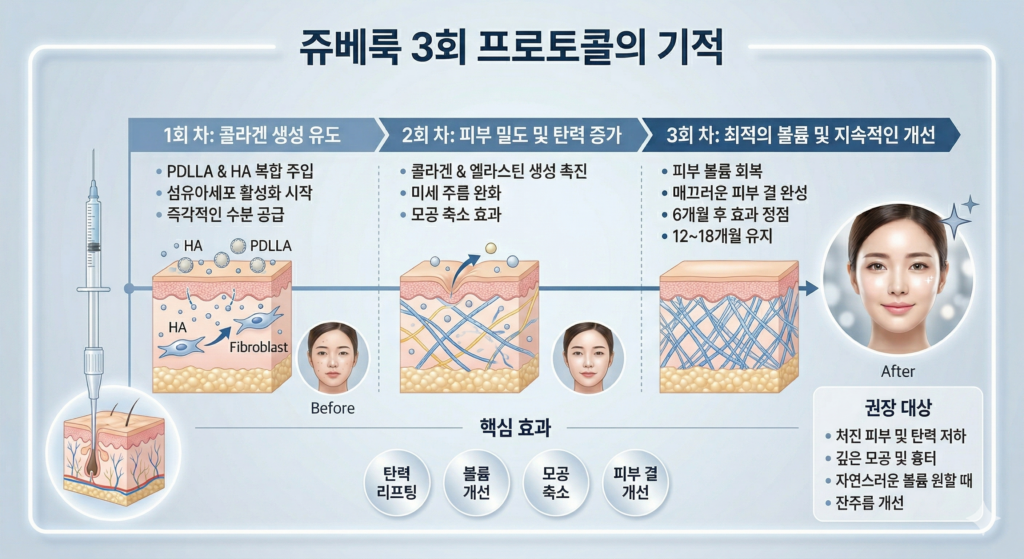
Immediately after the procedure, thanks to the HA (hyaluronic acid), your skin will feel hydrated and look dewy.
But the body absorbs this in 2-3 days.
“Huh? Did it all come out?” That's the exact moment to think that.
Real changes begin 4 to 8 weeks after the procedure.
This is the point where PDLLA microparticles stimulate fibroblasts, and new collagen gradually begins to accumulate. Reference: LM SKINCENTRE Hong Kong
So the recommended protocol is as follows.
3 treatments total, spaced one month apart.
You can consider these three as one set.
Why is it the third time?
Kickstart collagen production in the first round,
in the second round, increase collagen density,
It really takes hold in the third round. Reference: Bio Aesthetic Laser Clinic Singapore
In actual clinical studies, it has also been reported that dermal collagen density increased by 20-40% based on ultrasound measurements after 3-4 sessions. Reference: 1health.nz
And many people ask about the duration of Juvelook in Apgujeong.
After 3 sessions, the effects typically last 12-18 months, and with good management, can last up to 24 months. Reference: LM SKINCENTRE Hong Kong
You can maintain collagen levels with one touch-up treatment at 18-24 months.
Let me point out one common misconception among Korean patients here.
“I only got one treatment and my pores didn't shrink, so isn't it ineffective?”
No.
At the first stage, collagen has not yet accumulated sufficiently.
It's not like pouring water into a leaky pot; we're still in the stage of making the pot.
Especially in environments like Korea with dry seasonal changes and strong UV rays, collagen loss tends to be rapid, so it's really important to complete the 3-session protocol.
[Director Kim Young-kyun's Comment]
“There are quite a few people who get the first treatment and decide it's not effective. I completely understand how they feel. What I always tell them is, ‘Please consider it an investment for the first three treatments.‘ It's structured so that you sow the seeds in the first treatment and harvest the fruits in the third. If you stop in the middle, it's like you've just wasted the cost of the seeds.”
One-line summary: Apgujeong Juvelook should be viewed as a set of three treatments spaced one month apart. Collagen begins to establish itself 4-8 weeks after treatment, and the final results will be visible after completing all three sessions.
Should I be worried about nodule side effects?
If I have to summarize it in one line, nodules are not a ‘Juvelook problem,‘ but an 'injection method problem.'.
Apgujeong Juveruk nodule side effects.
There are quite a few scary articles when you search on Naver.
To be honest, it's natural to be worried.
But if you know the exact cause, you can reduce unnecessary worry.
I'll start by explaining why nodules form.
Nodules are a phenomenon caused by Juvelook's ingredients clumping together in one spot.
In other words, it's not a defect in the product itself, but rather when it's not evenly dispersed during injection. Reference: PMC/NIH — PDLLA Application in Dermatology
Academic literature also specifies ‘uneven distribution’ as the main cause of nodules.
In what cases would it be uneven?
There are three main things.
First, if the injection depth is incorrect.
Juvelook Original should be injected into the dermis. If it's injected too superficially, you may feel lumps on the skin surface.
Second, if too much is put in one point.
The basic approach is to apply it in small amounts to multiple points, but if you try to finish quickly by putting it all in one spot, it causes problems.
Third, if proper dispersion treatment is not performed after injection.
PDLLA is a formulation that does not require massage, but it does require a light hand-spreading procedure by the doctor immediately after the treatment.
This isn't a massage the patient performs; it's within the technique domain of the performing doctor.
And here's one misconception that Korean patients have.
“Does Juvelook cause more nodules than Sculptra?”
That is not true.
Rather, PDLLA is structurally less likely to form nodules because its particles are spherical and degrade uniformly compared to PLLA. Reference: PMC/NIH — PDLLA Application in Dermatology
Even if nodules develop.
It is mostly absorbed naturally within weeks and can be quickly improved with an injection of local steroids if needed. Reference: PMC/NIH — PDLLA Application in Dermatology
So, the conclusion is.
Saying you can't get Juvelook because you're afraid of nodules is like saying you can't ride in a car because you're afraid of car accidents.
You should leave it to someone who is a good driver.
Practitioner's experience and injection technique.
That's all there is to nodule prevention.
[Director Kim Young-kyun's Comment]
“In my 15 years of practicing dermatology, I've always felt that nodule issues depend 100% on the practitioner's hands. Uniform depth, uniform dosage, and uniform spacing. If you adhere to these three, you don't have to worry about nodules. At Core Dermatology, I personally perform all Juvelook procedures and meticulously adjust the depth and dosage at each injection point.”
One-line summary: The nodules are not a product issue but an injection technique issue, and can be prevented by performing the procedure with uniform depth, volume, and dispersion.
Which should I choose: Juvelook Volume or Juvelook Original in Apgujeong?
To get straight to the point, if you're concerned about skin texture, pores, and fine wrinkles, choose the original. If you're concerned about sagging volume, choose the volume.
This question, I get asked it really often in the doctor's office.
“Both are Juvelook, so what's the difference?”
The ingredients are the same. Both are PDLLA + HA.
The other things are concentration and usage.
Juvelook Original contains 42.5mg of PDLLA and 7.5mg of HA.
Juvelook Volume is PDLLA 170mg and HA 30mg. The main ingredient content differs by about 4 times. Reference: LM SKINCENTRE Hong Kong
Let me give you an analogy.
If the original is a nutrient mist that is thinly and evenly sprayed onto the entire face,
You can think of it as a nourishing cream that intensively fills in areas that have lost volume.
Specifically, it can be summarized as follows.
Who is the right candidate for Juvelook Original:
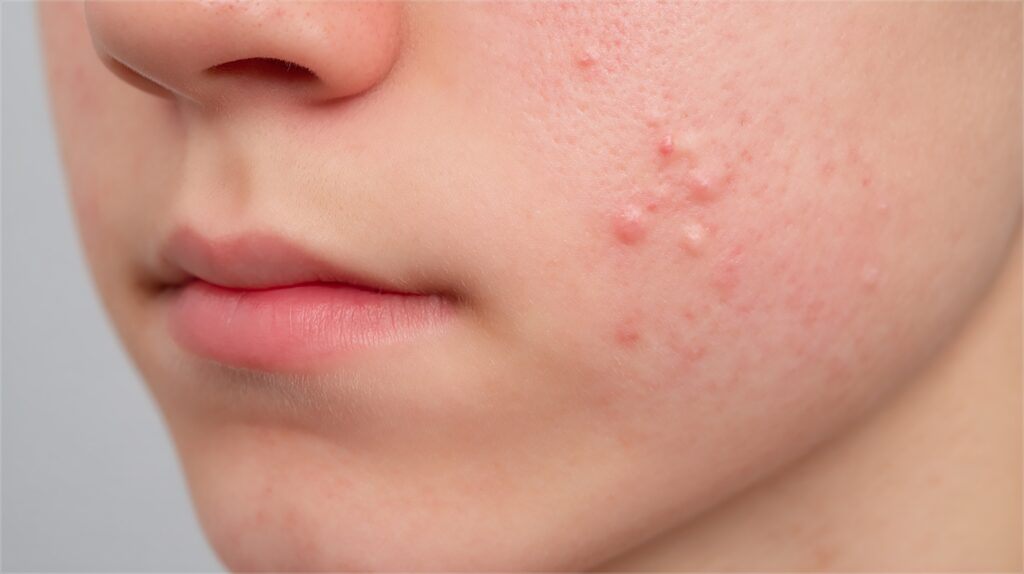
For those with rough skin texture or enlarged pores.
For those concerned about fine lines.
Anyone who wants to improve acne scars or uneven skin texture.
The infusion layer is the dermis, and it is applied evenly across the entire face.
Who is the right candidate for Juvelook Volume?
For those whose temples, cheeks, and nasolabial folds appear sunken.
For those who want to naturally fill in volume without fillers.
The particle size is 40-60μm, which is larger than the original, and it is injected into the subcutaneous fat layer (hypodermis). Reference: LM SKINCENTRE Hong Kong
And recently, a specific formulation for the eye area called Juvelook i has also been released.
The particles are much finer, about 20μm, so they can be used even on thin skin, such as under the eyes.
Honestly, some people might suit just one of the two formulations, but in reality, it's more common to use both together.
For example, you'd put in filler for cheek hollowness and finish with microneedling for skin texture.
This is an area that requires direct observation and judgment of the skin's condition, so I do not recommend deciding on “I want volume” without a consultation.
[Director Kim Young-kyun's Comment]
“Patients sometimes come in saying, ‘Isn't higher volume better based on online reviews?’ That's not necessarily true. Having a high PDLLA content isn't automatically better; the key is to use a formulation that suits your specific concerns and skin thickness. This judgment can only be made after physically examining and confirming the skin's thickness.”
One-line summary: The original is for improving skin texture, pores, and fine wrinkles, while Volume is for restoring lost volume. It is most accurate to decide on the formula that best suits your concerns after consulting with a specialist.
Are there things I must do before and after the procedure?
To get straight to the point, the golden time that determines the effectiveness is one week before the procedure and 48 hours after the procedure.
As it is an injection procedure, Apgujeong Juvelook naturally has pre and post-procedure care.
But it's not complicated. I'll just summarize the key points for you.
Things to avoid starting one week before the procedure:
Aspirin, Omega-3 (fish oil), Ginkgo Biloba extract, high-dose Vitamin E supplements.
These things interfere with blood clotting, making you bruise easily.
Do not stop taking prescribed medication arbitrarily; please speak to your doctor first. Reference: Bio Aesthetic Laser Clinic Singapore
It's also recommended to refrain from drinking alcohol starting three days before the procedure.
On the day of the procedure:
The procedure will begin approximately 20-30 minutes after applying the numbing cream.
The procedure time varies depending on the area, but it usually takes about 20 to 30 minutes.
How is the pain?
Honestly, it would be a lie to say I'm not hurting.
There's a stinging sensation because the needle goes in multiple times.
However, most people find it bearable if plenty of numbing cream is applied.
Immediately after the procedure ~ 48 hours:
This is the most important time.
Mild swelling and redness may appear at the treatment site, which usually subsides within 1-3 days. Reference: LM SKINCENTRE Hong Kong
Since there are multiple injection points, small bruises may occur, but these also disappear within 5-7 days.
Things to absolutely avoid during this period:
Intense exercise, sauna, jjimjilbang, swimming pool, direct sunlight, alcohol consumption.
You can wash your face gently, but absolutely do not rub the treated area harshly or use scrubs.
After 2 weeks post-procedure:
Avoid irritating ingredients like retinol, AHA/BHA for about two weeks.
You already know how important sunscreen is, but you really need to apply it meticulously during this time.
Especially during springtime in Korea.
As this is a time when both yellow dust and UV rays intensify simultaneously, be sure to use an SPF50+ sunscreen after your Juvelook procedure in Apgujeong and pay attention to cleansing after going out.
If you receive UV damage during a period when collagen is being newly created, it's like pouring water into a leaking bucket.
[Director Kim Young-kyun's Comment]
“Patients only focus on the procedure itself, but honestly, I believe that pre- and post-procedure care are 30%%of the total. Especially avoiding alcohol and saunas for 48 hours after the procedure, and thoroughly blocking UV rays for two weeks. Just adhering to these two things will significantly change the results.”
One-line summary: Discontinue blood-thinning medications and supplements one week before the procedure, avoid exercise, saunas, and alcohol for 48 hours after the procedure, and diligently use sunscreen for two weeks. These three points are the keys to maximizing the results.
When choosing a Juvelook clinic in Apgujeong, check only these things.
To get straight to the point, ‘who places it and with what protocol' determines 90%of the results, more than the equipment or price.
If you search for Juvelook in Apgujeong, you will find many clinics.
The price of Juvelook also varies greatly from hospital to hospital.
But why is the price different for the same product?
There are structural reasons for this.
First, whether to use genuine products.
You need to check if they are using genuine Juvelook that has been approved by the Ministry of Food and Drug Safety. Reference: MFDS Medical Device Information Portal
You can ask to see the product box before the procedure.
Skip hospitals that refuse this.
Next, capacity.
Jubeler Original is 2cc per vial.
Some hospitals use the entire vial, while others share one vial between two people.
Even with the same ‘one Juvéderm treatment," the actual amount that goes into your skin can differ.
So there's something you absolutely must ask during your consultation.
“How many cc of Juvelook are used in one treatment session?”
This one question is enough.
And most importantly, it's the practitioner.
As mentioned previously regarding nodules, the effects and side effects of Juvelook in Apgujeong are entirely dependent on the person administering the injections.
Things you need to check:
Is the procedure performed by a dermatologist directly?.
Before the procedure, will my skin condition be assessed and the formulation, dosage, and injection depth be individually designed?.
Does the same physician consistently perform the procedure during the three protocol sessions?.
If different people administer it each time in a factory-style hospital, the injection depth can vary between the first and second administrations.
This way, collagen won't accumulate evenly.
At Core Dermatology, I personally consult and perform all Juvelook procedures.
Adjusting slightly each time, observing the progress with the same hand and eye from the first to the third round.
That's the real skill.
[Director Kim Young-kyun's Comment]
“There's a reason why Juvelook in Apgujeong is cheap in some places and expensive in others. Don't just look at the price; you need to see what's included for that price. Authenticity of the product, the amount used, and the practitioner's expertise. If a clinic transparently discloses these three things, even if the price is a bit higher, it will ultimately be much more cost-effective.”
One-line summary: When choosing a Juvelook clinic in Apgujeong, be sure to check these three things: authenticity of the product, the dosage per session, and whether the procedure is consistently performed by a dermatologist.
Apgujeong Juvelook FAQ
If you are considering Juvelook in Apgujeong, be sure to have a one-on-one consultation with a dermatologist before the procedure to confirm the formulation and protocol that best suits your skin condition.
At Core Dermatology, Director Kim Young-gyun, with 15 years of experience as a dermatologist, personally consults and performs all Juvelook procedures. Designing a customized protocol that considers each patient's skin thickness, concerns, and lifestyle environment. That is the approach Core Dermatology strives for.
Don't just blindly choose based on reviews and cheap prices; please remember the three checkpoints I've outlined today.
I sincerely hope you make the best choice for your skin.
Thank you for reading the long text.
Sincerely, Kim Young-gyun, Chief Director of Core Dermatology
Scales of justice Legal Notice
This article was written in compliance with Article 56 of the Medical Service Act and the Medical Advertising Review Standards. The effects of the procedure may vary depending on an individual's skin condition, constitution, and lifestyle habits, and we do not guarantee that the effects mentioned in this article will appear the same for all patients. Side effects related to the procedure (swelling, bruising, redness, nodules, etc.) may occur, so please be sure to make a decision after consulting thoroughly with a specialist. The clinical research results cited in this article were derived under specific research conditions and may not represent general procedure outcomes.
📚 References
- LM SKINCENTRE — Juvelook PDLLA Collagen Stimulator Hong Kong
- Clifford Clinic — Juvelook: Revolutionizing Skincare with PDLLA Skin Boosters
- PMC/NIH — Poly-d,l-lactic Acid (PDLLA) Application in Dermatology (2024)
- V Aesthetics Clinic — The Long-Term Benefits of PDLLA for Skin Health
- Bio Aesthetic Laser Clinic — Juvelook Treatment Singapore
- 1health.nz — Understanding Microfillers: Rejuran, Juvelook, Sunekos Explained
- Juveruck Official Site (Hana Pharm)
- MFDS Medical Device Information Portal



 한국어
한국어  English
  日本語
日本語  简体中文
简体中文