
From the effect to the longevity of the Apgujeong Hilo Wave, why it's less foreign than fillers

“Director, my cheeks look sunken, making my nasolabial folds appear deeper... Should I get fillers? But fillers are a bit of a concern...”
✅ Conclusion first
HilloWave is a dual HA biostimulator that combines high and low molecular weight hyaluronic acid. Unlike fillers that “fill” volume, this treatment induces the skin to produce collagen on its own. Changes in deep hydration can be felt from the day after the procedure, and the effects last for approximately 4 to 9 months per session.
Hello. This is Kim Young-gyun, CEO and Director of Core Dermatology.
I hear that a lot in the examination room.
Filler's immediate volume is appealing, but many people worry about it looking unnatural, right?
So, recently, there's been a lot of interest in a new category called “collagen booster injections.”.
Among them, the number of people visiting and consulting at Hillowave in Apgujeong has significantly increased.
Today, I will summarize the key information that those considering a Heiloweave must know before the procedure.
I'll tell you honestly what the differences are from fillers, how long the effects last, and if there are any side effects.
What kind of procedure is Apgujeong Hilo-wave?
To get straight to the point, HiloWAVE is a ‘Dual HA Biostimulator' that combines high-molecular-weight and low-molecular-weight hyaluronic acid, and it's a next-generation collagen booster injection that induces the skin to produce collagen and elastin on its own.
My name might be a little unfamiliar.
Let's break it down easily.
Our skin contains a moisture-retaining substance called hyaluronic acid (HA).
Hyaluronic acid is used in both fillers and skin boosters.
Even with the same ingredient, its role within the skin can change completely depending on its molecular size and how it's bonded.
Hillowave applied its proprietary structure called DHC (Dual Hyaluronic Acid Compound).
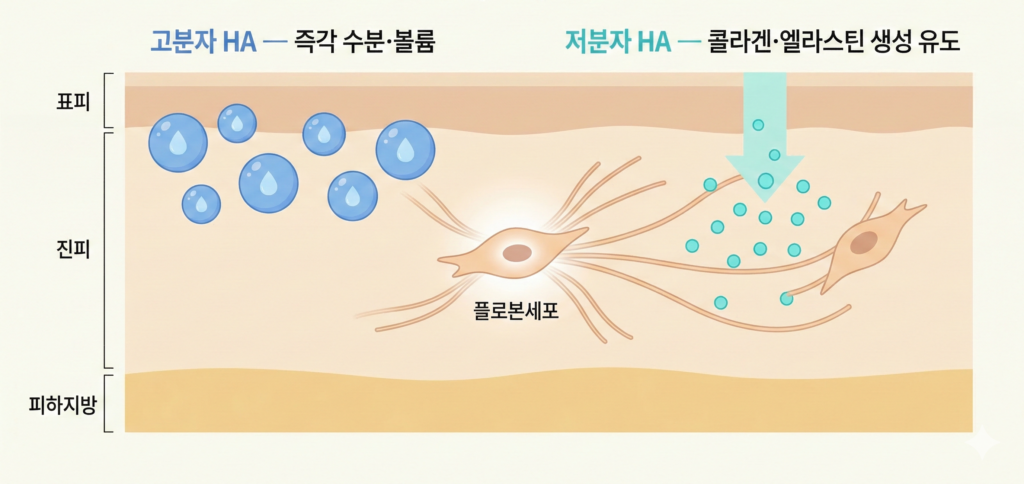
Immediately after the procedure, the polymer HA retains moisture, creating instant radiance and volume.,
Low molecular weight HA diffuses deep into the dermis to stimulate fibroblasts. Reference: HILO WAVE Official.
Fibroblasts are like factories within the skin that produce collagen and elastin.
When this [product/treatment] becomes active, it increases skin density, improves elasticity, and reduces fine wrinkles.
There's one more important thing.
The HA concentration of HiloWave is 24mg per 1cc.
This is a highly concentrated formulation, two to three times that of typical moisturizing injections or skin boosters. Reference: Aesthetic News Korea.
Even if the same amount is injected, it means that the active ingredients delivered into the skin are that much greater.
[Director Kim Young-kyun's Comment]
“Some people think of Apgujeong Hilla-wave as simply an ‘upgrade of the water glow injection.‘ It's more accurate to understand it as a ”collagen-stimulating volumizer" that sits between a skin booster and a filler. You can think of it as a procedure that makes your skin fill up on its own, rather than being filled.”
📍 One-line summary: HilloWave = Biostimulator based on dual HA (high molecular weight + low molecular weight), a procedure that induces the skin's own collagen production
What's the difference between fillers and HiloWave?
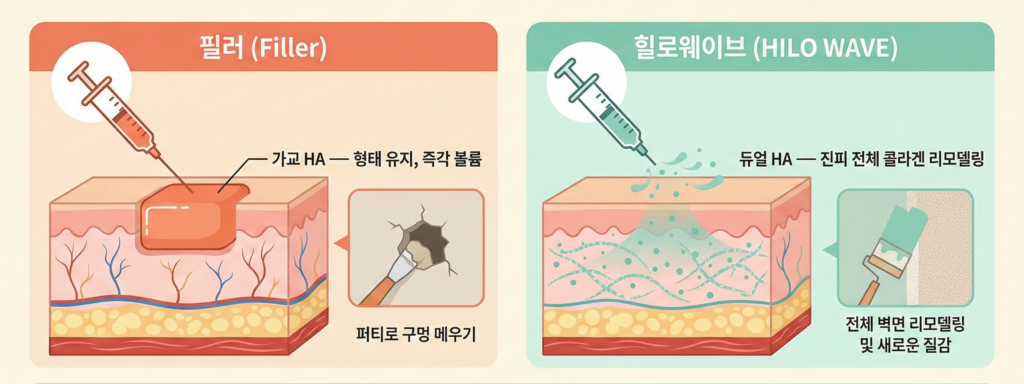
In summary, fillers are procedures that ‘fill’ specific areas with cross-linked HA, while Healowave is a procedure that induces collagen remodeling throughout the dermis to ‘build’ natural volume and elasticity.
To understand this difference, you only need to remember one word: BDDE.
BDDE is a cross-linking agent (adhesive) that tightly binds hyaluronic acid particles together.
General fillers use a lot of BDDE to create a firm mass of hyaluronic acid.
This way, the shape is maintained when placed on areas like the chin.
On the other hand, HiloWave minimized the use of BDDE. Reference: Aesthetic News Korea.
Thanks to this, it spreads gently within the skin, causing collagen remodeling throughout all layers of the dermis.
If I could give you one analogy that patients in the exam room understand most easily.
If filling a hole in the wall with putty,
Hellowave is closer to a renovation, transforming the wall itself into new wallpaper and repainting it.
So the results are also different.
Immediately after the filler procedure, you can see, “Ah, there's volume here now.”.
A few days after the procedure, Healowave makes you feel like “my skin has become healthier,” “my makeup applies better,” and “my cheeks have naturally filled out.”.
To be honest, fillers are still suitable for areas that need to create a distinct shape, such as the chin.
Hellowave isn't a cure-all, is it?.
However, in areas that require natural filling, such as sunken cheeks, nasolabial folds, and midface depression, HiloWave can be expected to yield more natural results than fillers.
[Director Kim Young-kyun's Comment]
“We had a patient in her early 40s (pseudonym: Ji-hyun Lee). She had received filler injections twice for cheek hollowness but felt uncomfortable as the filler seemed to droop downwards over time. After switching to HiloWave, she described it as ‘not a feeling of being filled, but rather my own original cheeks returning.” Of course, there can be individual differences, but we recommend this to those who desire such natural changes.”
📍 One-line summary: Filler = a procedure to fill in contours / Healowave = a procedure that enhances both skin quality and natural volume. Since the purposes are different, neither is “better” than the other.
When do the effects start to appear and how long do they last?
Specifically, you'll feel changes in moisture and radiance the day after the procedure, with elasticity and volume stabilizing around 4 weeks later. The results typically last about 4 to 9 months per session.
I will arrange the effects in chronological order.
Immediately after the procedure ~ 2-3 days: The first thing you'll notice is a significant reduction in dryness. Many people say, “The tight feeling after washing my face is gone.” Your skin will start to look radiant, giving you that ‘dewy’ look. Reference: Aesthetic News Korea.
Weeks 1-2: Fine lines become less noticeable, and skin texture begins to refine. This is the point where low-molecular-weight HA stimulates fibroblasts in the dermis, initiating collagen synthesis.
Around 4 weeks This is the period when elasticity and volume are most stably established. Most people who say, “I haven't gained weight, but my cheeks look fuller,” give us this feedback at this time.
What about the duration of maintenance?
The average perceived duration of effect is about 4-6 months per treatment. Reference: Aesthetic News Korea, cases are reported to last up to 9 months depending on skin condition and lifestyle.
Here's one important point.
It is known that if you have three consecutive treatments at three-month intervals, the collagen accumulation effect will be cumulative, and the effect can last up to 18 months.
Occasionally, some people feel that the maintenance period is short after receiving it only once.
You need to remember that biostimulators are procedures that build collagen density through repeated treatments.
It's not pouring water into a leaky jar, but rather a process of gradually thickening the bottom of the jar.
[Director Kim Young-kyun's Comment]
“Some people occasionally feel that the effects are weak after the first treatment. However, Heilowave is not a procedure that instantly adds volume like fillers. Most people experience changes in skin texture, radiance, and makeup adhesion after waiting about two weeks. It's important to wait long enough.‘
📍 One-line summary: Next day: Moisture boost → 2 weeks: Skin texture refinement → 4 weeks: Elasticity and volume stabilization / Lasts 4-9 months per session, up to 18 months with 3 sessions
Are there any side effects? What about nodule concerns?
To get straight to the point, Hellowave is designed with minimal BDDE cross-linker and based on hyaluronic acid, thus significantly reducing the risk of nodule formation and foreign body reactions compared to existing polymer-based biostimulators.
We can't *not* talk about the side effects, can we?
To be honest, there are no injectable procedures in the world with zero side effects.
Since Hillewave is also a procedure that injects hyaluronic acid,
Temporary reactions such as bruising, swelling, and redness may occur at the treatment site.
However, most will disappear naturally within 1-3 days. Reference: Arium Clinic Singapore.
How about the nodule you're most concerned about?
Polymer-based biostimulators like PLLA, CaHA, and PCL, which have been widely used as collagen boosters, stimulate collagen by causing foreign body reactions in the skin.
The effects are good, but side effects such as palpable nodules (hard lumps) due to excessive stimulation have been reported.
Apgujeong Hillowave has a completely different approach.
It induces collagen production with hyaluronic acid, not foreign substances, and minimizes the BDDE cross-linking agent, resulting in fewer foreign body reactions. Reference: HIGHER Corp. Blog.
And one more thing.
This is something I always tell my patients.
Existing PLLA or CaHA products could not be dissolved once injected.
I just had to wait even if nodules appeared.
Because Hilla-wave is hyaluronic acid-based, it can be dissolved with hyaluronidase (hyaluronic acid-degrading enzyme) in case of an emergency.
This is a significant difference in terms of safety.
[Director Kim Young-kyun's Comment]
“The most important factor in minimizing side effects is actually the injector's ability to control injection depth and dosage, rather than the product itself. You need to accurately understand the anatomical structures and set different depths for each area to minimize bruising and swelling. This is why you should receive treatment from a dermatologist with ample experience, even if the product is safely designed.”
📍 One-line summary: Low risk of nodules, dissolvable with hyaluronidase—however, there is no injection with “zero side effects,” so choosing an experienced specialist is key.
Who is the Apgujeong Hilo Wave best suited for, and who should be cautious?
Specifically, it is suitable for those who are concerned about dryness, fine wrinkles, and sunken cheeks simultaneously, and who feel burdened by the artificial volume of fillers, while fillers may be more suitable for deep wrinkles or significant contour changes.
“Is this the right treatment for me?” - That's actually what you're most curious about, isn't it?
Here are the common characteristics of those who are particularly well-suited for Apgujeong Hillowave.
For those who suffer from severe dryness that causes makeup to flake off in the afternoon, no matter how many layers of basic skincare they apply,
For those whose cheeks have started to slightly sag but feel it's too much to fill with fillers,
For those who are often told they look tired because the area around their nasolabial folds appears shadowed,
And for those who have been postponing the procedure due to downtime.
Especially in Korea's climate, where the transition period like now, fine dust and dry weather combine, causing extreme inner dryness,
Often, a procedure is needed that goes beyond simple moisturizing to change the hydration environment from the dermis.
Apgujeong Hilo Wave can be a good option for people like this.
On the other hand, there are definitely times when you need to be cautious.
For areas that require a distinct shape, like the chin, fillers are suitable.
Even in situations where you need to instantly fill in deep wrinkles, Hylorave alone may not be enough.
Also, if you have a wedding or an important photoshoot within three days, there might be slight swelling remaining in the treated area, so we recommend having the procedure at least one week prior.
Here it is, categorized by treatment area.
The mid-face (cheeks and cheekbones), the area around smile lines, and sunken cheeks are strong areas for HiloWave.
Areas such as the forehead, nose, lips, and jawline are areas for fillers.
[Director Kim Young-kyun's Comment]
“Based on the director's experience, those who are most satisfied with HiloWave in Apgujeong are individuals in their late 30s to 40s who feel their ‘entire skin is dull and lacks vitality.‘ The benefits are significant for those who want to improve the overall quality of their face, rather than just filling in specific areas. Conversely, if your goal is to change your shape, such as ’wanting to heighten your nose‘ or ”create a jawline," HiloWave is not suitable.”
📍 One-line summary: Dry skin + fine lines + sagging cheeks simultaneously concerns → Suitable / Clear shape change needed → Fillers are suitable
When choosing a Hilo wave clinic in Apgujeong, what should you check?
To get straight to the point, the three most important things to check are whether there is direct consultation with a dermatologist at Hillowave Clinic in Apgujeong, whether you can choose the injection technique, and whether there is a retouching system after the procedure.
Since the Apgujeong and Cheongdam areas are densely populated with dermatology clinics, there are quite a few hospitals that handle Apgujeong Hellowave.
The price difference is also huge between hospitals.
However, there's a reason why results can vary even when using the same product.
First, who designs the diagnosis and injection?.
HilloWave is performed using two techniques: a point injection method called P.D.I.T. (Point Deep Inject Technique) and an area injection method using a cannula. Reference: HIGHER Corp. Blog.
If you need micro-volume for specific areas like laugh lines, P.D.I.T. is advantageous,
If your goal is to improve overall skin quality, such as dryness and texture, cannulas are effective.
Whether or not this can be combined according to the patient's skin condition makes a difference in the results.
Second, don't choose solely based on price.
The market price in the Apgujeong area for Hilowave 2cc is approximately 500,000 to 700,000 won.
If it's excessively cheap, it could be an ‘assembly line’ operation where procedures are performed quickly without sufficient consultation time.
Since Hilo wave is a procedure that requires precise control over depth and capacity for each area,
It is essential to have a process where a dermatologist directly examines the skin and reviews past treatment history before designing a plan.
Third, check if there is a touch-up system after the procedure.
The process of fine-tuning left-right symmetry and volume balance by area, observed over 2 to 4 weeks after the procedure, significantly enhances satisfaction with biostimulators.
It's advisable to check if the hospital has a system in place for ongoing care and management, not just a one-time treatment.
[Director Kim Young-kyun's Comment]
“At Core Dermatology, before the Hillowave procedure, our director personally assesses your skin type, past procedures, and volume preferences to design the depth, dosage, and technique for each area. We conduct follow-up consultations between weeks 2 and 4 post-procedure, and include minor adjustments for symmetry if necessary. We urge you not to choose solely based on reviews or low prices, but to find a place where a specialist meticulously plans your treatment.”
📍 One-line summary: Choose a place that offers: direct consultation with a specialist, technique selection (P.D.I.T./cannula), and a post-procedure retouch system.
Apgujeong Hillowave FAQ
If you are considering Hilo Wave in Apgujeong, please be sure to have a 1:1 in-person consultation with a dermatologist before the procedure to thoroughly check if it is suitable for your skin condition and treatment goals.
At Core Dermatology, we conduct personalized, area-specific designs based on the 15 years of clinical experience of our dermatology specialists, comprehensively analyzing each patient's skin type, previous treatment history, and volume preferences. We also include consultations for follow-up appointments at 2-4 weeks post-procedure and fine adjustments for symmetry. Please feel free to contact us with any inquiries.
Rather than choosing based solely on reviews and cheap prices, I urge you to first find a specialist who will delicately read your skin.
Thank you for reading the long text.
Sincerely, Kim Young-gyun, Chief Director of Core Dermatology
⚠️ Notice of Medical Law Compliance This content is provided for informational purposes and does not guarantee the effectiveness of any specific procedure. Procedure results may vary depending on individual skin condition, constitution, lifestyle, and other factors. Side effects (such as bruising, swelling, redness, nodules, etc.) may occur. Accurate diagnosis and determination of suitability for a procedure must be made through in-person consultation with a medical professional at a healthcare institution. This post is informational content that has not undergone medical advertising review.
📚 References



 한국어
한국어  English
  日本語
日本語  简体中文
简体中文