
Apgujeong Coolsonic: 5 Things You'll Lose Out On If You Don't Know Before the Procedure — From Principles to Pain, Effects, and Precautions

“I want to get a lifting procedure, but Ultherapy sounds too painful, so I'm hesitant.”
“I've had treatments like Shrink, but I felt a little disappointed. Is there something better?”
✅ Conclusion first
Apgujeong CoolSoniq is a cooling High-Intensity Focused Ultrasound (HIFU) lifting device that delivers high-output ultrasound to the SMAS layer at depths of 1.5mm, 3.0mm, and 4.5mm while cooling the skin surface with its patented ACC™ cooling technology. The collagen regeneration effect becomes noticeable 8-12 weeks after the procedure and can be maintained for about 3-6 months or longer, depending on individual differences.
Hello. I am Kim Young-kyun, the representative director of Core Dermatology. I am surprisingly often asked this question in the consultation room.
For those postponing lifting due to pain, and for those who want results but are burdened by downtime.
I completely understand their feelings.
Today, regarding CoolSoniq, which is rapidly gaining attention in the recent Apgujeong ultrasound lifting market,
Here are 5 things you absolutely need to know before the procedure, frankly explained.
Apgujeong How is Coolsonic different from existing ultrasound lifting treatments?
To get straight to the point, Coolsonic is ‘HIFU that cools while it shoots'.
Existing HIFU (High-Intensity Focused Ultrasound) lifting devices—such as Ultherapy and Shurink—all share the same principle: delivering ultrasound energy deep into the skin to induce collagen regeneration in the SMAS layer.
However, there was one problem here.
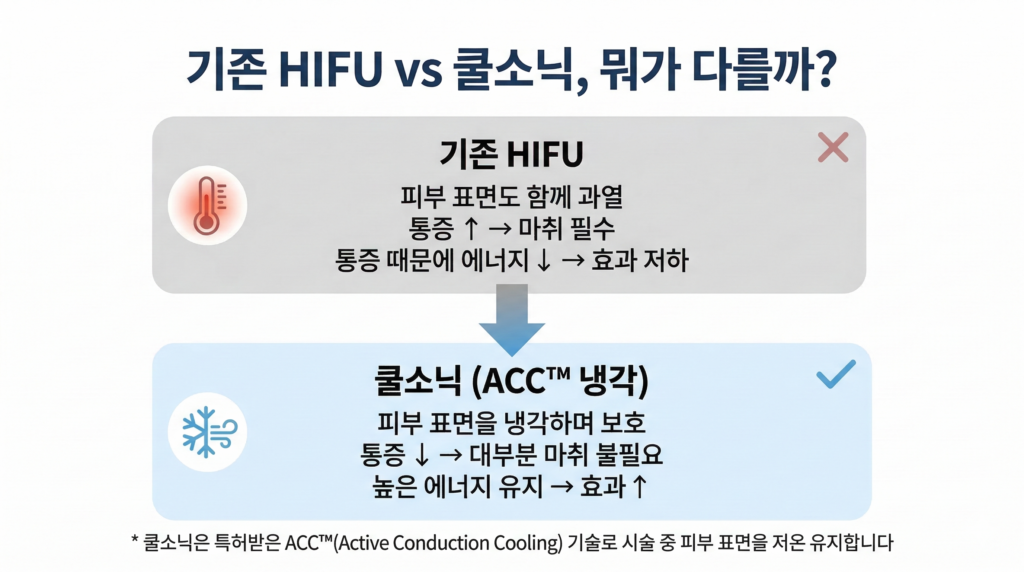
The process of ultrasonic energy reaching deeper layers also heats the skin's surface.
So the pain was severe, and because of the pain, I had to lower my energy levels, and when I lowered my energy levels, the effectiveness decreased, creating a vicious cycle.
Apgujeong Coolsonic is equipment that directly addresses this problem.
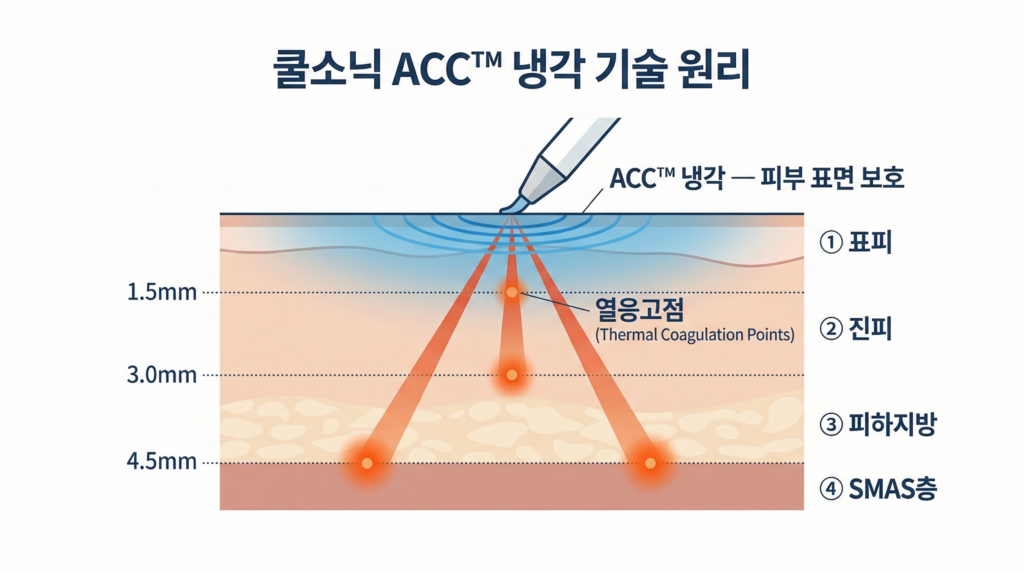
Developed by manufacturer Asterasys ACC™ (Active Conduction Cooling) The technology incorporates a patented micro-cooling module (Korean Patent No. 10-2842717) at the tip of the applicator, maintaining the skin contact surface at a low temperature during ultrasound irradiation. Reference: Kulsonic Global Official
To put it simply, it's like this.
Imagine you're placing food on a hot frying pan, but the handle always stays cool.
It delivers sufficient thermal energy deep into the skin (1.5mm, 3.0mm, 4.5mm) while protecting the skin's surface with cooling. Reference: Coolsonic Korea Official
Another point worth noting is Pen-type applicator.
Most existing HIFU devices use a method where a wide cartridge is placed on the skin and then pulsed line by line.
Coolsonic uses a pen-like applicator with a small contact area.
This allows for close contact even in curved areas like under the eyes, around the mouth, and under the chin, ensuring complete energy delivery. Since it's delivered with a rubbing motion in the "rubbing mode," the treatment time is also significantly reduced. Reference: Kulsonic Global Official
For your reference, Asterasys officially exports its products overseas under the brand name CoolSoniq. In regions where the brand name may be unfamiliar, it is also referred to as “Cooling HIFU” or “HIFU with Cooling System.”.
The official name according to the Ministry of Food and Drug Safety's product classification is “Focused Ultrasound Stimulation System,” which is a medical device that uses focused ultrasound to coagulate tissue for lifting purposes. Reference: MFDS Medical Device Information Portal
[Director Kim Young-kyun's Comment]
“To be honest, it's more accurate to understand Coolsonic as a device that shares the same HIFU principle but adds a new approach with cooling, rather than definitively calling it an ‘alternative to Ultherapy.‘ The results depend more on how precisely the energy depth and number of shots are designed to match your skin condition, rather than the superiority of the device itself.”
One-line summary: Apgujeong Coolsonic = HIFU Principle + ACC™ Cooling Technology + Pen-Type Applicator → Pain↓ Energy Delivery Power↑
CoolSculpting, Does It Really Not Hurt? — An Honest Talk About Pain and Anesthesia
In summary, it's significantly less painful than traditional HIFU, making most treatments possible without anesthesia.
“The perception that ”HIFU = painful" is quite deeply rooted, isn't it?.
There were quite a few people who actually received treatment with existing HIFU equipment and described it as “feeling like it was stabbing my bone” or “tears were streaming down my face.”.
The reason for the reduced pain with CoolSoniC is due to the ACC™ cooling technology I mentioned earlier.
From the moment the applicator touches the skin, the contact surface is maintained at a low temperature, significantly reducing the thermal stimulation on the surface skin as the ultrasound energy travels to deeper layers. Reference: HeydayClinic CoolSoniq
Here's a summary of the reactions from those who received treatment in the examination room.
“Just a slight warmth? It stings a little, but it's bearable.” — Ms. A, a woman in her 40s (procedure without anesthesia)
“Compared to when I got Ultherapy, it feels like less than half the pain.” — Ms. B, a woman in her 30s
Of course, ‘not feeling pain" is an area with a lot of individual variation.
To be honest, you might feel a slight throbbing sensation in bony areas like the forehead or chin, and individuals with high pain sensitivity may also opt for cream anesthesia.
However, with traditional HIFU, patients often experienced pain even with anesthesia, leading to frequent reductions in energy levels. The key difference with Coolsonic is that thanks to its cooling technology, treatments can be performed while maintaining energy levels close to maximum output.
This is important because.
In lifting procedures, energy output is directly linked to effectiveness.
No matter how good the equipment is, if you reduce the energy by half due to pain, it's like pouring water into a leaky jar.
CoolSonic's cooling technology is not just a ‘convenience feature,' but rather Key design for enhanced effectivenessYou should see it as follows.
[Director Kim Young-kyun's Comment]
“When patients undergo treatment comfortably, it allows the practitioner to deliver sufficient energy to the required areas without omission. ‘Less pain” goes beyond mere comfort; it also means it becomes a condition that can improve the completeness of the procedure.”
One-line summary: Coolsonic pain is significantly milder compared to existing HIFU, and treatments are possible at near maximum output without anesthesia.
Apgujeong Cool Sonic, When do the effects start to appear, and how long do they last?
Specifically, you may feel some tightening immediately after the procedure, but the full changes will be noticeable 8-12 weeks later.
“Does my jawline change immediately after the procedure?”
Many people ask this question.
To be honest, HIFU-based procedures are not surgery.
If you expect dramatic changes on the day of the procedure, you may be disappointed.
I will explain in order what Coolsonic does inside the skin.
Immediately after the procedure ~2 weeks: Ultrasound energy forms microscopic thermal coagulation points at 1.5mm (sub-epidermal), 3.0mm (deep dermal layer), and 4.5mm (SMAS layer). This heat causes existing collagen fibers to contract, resulting in an immediate ‘tightening" sensation. Reference: DermClear Singapore
2 to 8 weeks The body's natural healing response begins around the thermal coagulation site. According to a 2023 study by Cho et al., the application of HIFU leads to a decrease in intracellular Cav-1 (aging-related protein) levels and an increase in ERK1/2 phosphorylation, which promotes fibroblast proliferation and the synthesis of collagen and elastin. Reference: Cho et al. 2023 PMC
8-12 weeks later: As the new collagen matrix becomes fully established, noticeable improvements in skin elasticity, jawline contour, and nasolabial folds begin to appear. The most distinct results typically emerge between approximately 3 to 6 months post-treatment.
Then, what is the duration of the Apgujeong Coolsonic effect?
According to the systematic review by Biskanaki et al. in 2025, the most significant improvement after HIFU treatment occurs between 90-180 days, with approximately 88%of patients experiencing noticeable improvement according to the Global Aesthetic Improvement Scale (GAIS) criteria, and effects can last up to 18 months. Reference: Biskanaki et al. 2025
However, this figure is a result that encompasses various HIFU devices, and the actual duration of effect varies significantly depending on age, skin condition, lifestyle, and UV exposure.
There is one misunderstanding that I would like to correct.
“Will one session make it permanent?” — Absolutely not.
HIFU treatments *induce* collagen regeneration, they do not stop aging itself.
To maintain the effects consistently, it is common to consider touch-up procedures every 6 to 12 months.
[Director Kim Young-kyun's Comment]
“Based on my experience as a director, the satisfaction levels are much higher for those who approach treatments with a long-term perspective, expecting management over a 6-month to 1-year period, rather than hoping for a ‘one-and-done‘ result. Some people get impatient and judge that there's ”no change" just two weeks after a procedure because they want to see immediate effects. However, collagen regeneration takes time. We would appreciate it if you could wait a little longer.”
One-line summary: The Coolsonic effect is normally felt from 8-12 weeks, peaks at around 3-6 months, and the maintenance period can last up to 18 months depending on individual differences.
What should you know about pre- and post-treatment precautions, and side effects?
To get straight to the point, Coolsonic is a non-invasive procedure with almost no downtime, but it is not ‘zero contraindications.".
First, I will tell you about the side effects.
Reactions that may occur after an Apgujeong Coolsonic procedure are mostly mild and temporary.
Temporary redness, slight swelling, tingling, and throbbing may occur and will mostly disappear naturally within a few hours to a few days.Reference: AEON Medical Singapore
Rare cases of bruising or decreased sensation have been reported, but a 2025 review of 22 studies found that most severe side effects from HIFU were caused by improper application by the practitioner (excessive energy settings, treating prohibited areas, or repeated treatments at short intervals). Reference: Biskanaki et al. 2025
There is one point that requires special attention.
When irradiating the SMAS layer (4.5mm), from the previous procedure A minimum interval of 6 monthsmust be placed.
Repeated procedures at short intervals in deep layers carry the risk of fat atrophy (hollowing of the cheeks).
“For HIFU, the idea that ”the more you get, the better" is a truly dangerous misconception.
Apgujeong Cool Sonic, Pre-procedure checklist
It is recommended to discontinue the use of retinoids (Vitamin A derivatives) and high-concentration acidic cosmetics for several days prior to the procedure.
On the day of your procedure, please avoid heavy makeup or exfoliants.
And for people like this, the procedure itself is difficult.
Individuals who are pregnant or breastfeeding, have active skin infections or severe cystic acne, have a pacemaker or metal implants, or have severe autoimmune diseases or bleeding disorders must consult with their doctor in advance. Reference: Biskanaki et al. 2025
Post-Procedure Care: Practical Tips Tailored to the Korean Environment
Actually, many people miss this part.
To ensure that the ultrasound heat is effectively maintained within the skin after the procedure Wash face with lukewarm water for 3 daysis recommended.
It is best to avoid washing your face with hot water or going to saunas and jjimjilbangs for at least one week.
For those receiving treatments during seasonal transitions in Korea, particularly during the severe yellow dust and fine dust season in spring, it is essential to thoroughly apply sunscreen (SPF 30 or higher) when going outdoors.
After the procedure, your skin can become temporarily sensitive, making it more vulnerable to UV rays.
It's best to avoid strenuous exercise on the day of the procedure, and abstaining from alcohol within 48 hours will aid in recovery.
[Director Kim Young-kyun's Comment]
“Many people surprisingly think that since Apgujeong Coolsonic has almost no downtime, there's nothing to manage afterwards. However, it's no exaggeration to say that the 1-2 weeks of post-treatment care determine the quality of collagen regeneration for the following 2-3 months. In particular, please be sure to pay attention to sun protection and moisturizing; these two are crucial.‘
One-line summary: CoolSonic side effects are mostly mild and temporary, and recovery is quick if you follow basic post-treatment care, such as sun protection, washing with lukewarm water, and avoiding saunas.
Apgujeong Coolsonic: Who is it best suited for? - Differences with Ulthera and Shurink
In summary, it may be suitable for those who are sensitive to pain and desire a lifting effect that reaches the SMAS layer.
There's a question that people who consult about Apgujeong Coolsonic ask most often.
“How is it different from Ulthera?”
“Is one Coolsonic session better than three Shlink sessions?”
I will organize this part for you.
Comparison with Ultherapy:
Ultherapy is a representative HIFU device approved by the FDA, with the advantage of being able to perform treatments while visually confirming the target layer through real-time ultrasound imaging (MFU-V). However, the treatment can be quite painful, often requiring anesthesia, and even with anesthesia, the energy level is frequently reduced. Reference: Ulthera Official
Coolsonic does not have a visualization feature, but it has the distinct advantages of reducing pain with ACC™ cooling technology while maintaining high energy and an accessible pen-type applicator for curved areas. Reference: Kulsonic Global Official
To put it simply, the difference between Coolsonic and Ulthera is: “They share the same HIFU principle but approach it differently.”.
Comparison with Shrink:
Shrink (including Shrink Universe) is one of the most common HIFU devices in Korea, offering good price accessibility and various depth cartridges. However, there are opinions that its dot (thermal coagulation point) size is smaller compared to Coolsonic or Ulthera, which may require more shots or repeated procedures for the same effect. Reference: Shrink Classys Global
Then, who is Coolsonic suitable for?
Individuals with mild to moderate skin laxity (blurry jawline, early jowls, deepened nasolabial folds) who are sensitive to pain.
For those who want to receive lifting treatments during their lunch break without taking time off from their busy schedules.
For those who have previously had Ultherapy and want a “stronger effect.”.
For those who want to meticulously care for curved areas such as around the eyes, mouth, and under the chin.
Conversely, for people like this, Coolsonic alone may have limitations.
Individuals with severe skin laxity (thread lifting or surgery may be more suitable).
For those whose main concern is volume loss (requires concurrent treatment with volume replenishment procedures such as fillers).
If deep wrinkles are caused by a lack of volume (which lifting equipment alone cannot solve).
[Director Kim Young-kyun's Comment]
“There is no universal solution. I cannot say that Coolsonic is the answer to all skin concerns. However, it is true that for those who gave up on lifting due to pain, there are now significantly more options. The best approach is to get your skin condition diagnosed in person and then decide whether Coolsonic alone is better or if it should be combined with other procedures.‘
One-line summary: Coolsonic is suitable for those who want a lifting treatment that reaches the SMAS layer without pain, and it is a HIFU-based treatment with the same principle, just a different approach than Ulthera and Shurink.
Apgujeong Coolsonic FAQ
If you are considering Coolsonic lifting in Apgujeong, it is highly recommended that you consult with a dermatologist for a 1:1 consultation before the procedure to thoroughly check your skin condition, degree of sagging, and past treatment history.
At Core Dermatology, our Medical Director, Dr. Kim Young-kyun, with 15 years of experience as a dermatologist, comprehensively evaluates each patient's skin thickness, sagging patterns, and lifestyle. Based on this assessment, we design a personalized treatment plan, determining whether Coolsonic alone is suitable or if combining it with other procedures would be more beneficial.
Please don't just choose based on reviews and low prices. We ask that you make your decision after thoroughly discussing your skin with a specialist who has examined you in person.
Thank you for reading the long text.
Sincerely, Kim Young-gyun, Chief Director of Core Dermatology
Legal Notice This content is provided for informational purposes only and does not guarantee the effectiveness of any specific procedure. Procedure results may vary depending on individual skin condition, age, lifestyle, and other factors. It is essential to consult directly with a dermatologist to determine if a procedure is appropriate for you. The medical figures and research results included in this text are referenced from the publications and institutions of the respective papers/organizations and do not apply uniformly to all patients.
📚 References
- CoolSoniq Global Official Site
- CoolSonic Korea Official Site
- DermClear Aesthetic & Laser Clinic — HIFU Treatment Singapore
- AEON Medical — Comprehensive Guide to HIFU Benefits, Risks, and Recovery
- Biskanaki, F., et al. (2025). Complications and Risks of HIFU in Esthetic Procedures: A Review. *MDPI Applied Sciences*.
- Cho YR et al. (2023) — HIFU Increases Collagen and Elastin Expression in Aging Skin via Cav-1 Modulation, PMC
- PS Medical Centre Hong Kong — HIFU vs Thermage Pros and Cons
- HeydayClinic Global — CoolSoniq
- MFDS Medical Device Information Portal
- Asteracis Official Website



 한국어
한국어  English
  日本語
日本語  简体中文
简体中文