
CoolPeel: Is it really painless Thermage? — A dermatologist compares.
✍️ Kim Young-gyun | Director of Core Dermatology and Plastic Surgery, Dermatologist (License No. 106824)
📅 03.30.2026 | 🔬 Based on clinical experience + academic data
✅ Conclusion first
Coolpease uses the same monopolar RF (monopolar radiofrequency) principle as Thermage, but it is a next-generation radiofrequency lifting device that shows equivalent lifting and skin elasticity improvement effects while reducing procedure pain by about 46% with its patented Direct Contact Cooling (DCC) technology. Reference: PMC Severance Clinical Trials
📌 The core of this article
• Coolpeel and Thermage both use monopolar RF—the key difference is the cooling method (DCC vs. refrigerant spray).
• Pain score based on 300 shots in a 22-person comparative clinical trial: CoolPeel family 4.5 vs. Thermage 8.4
Lifting and elasticity are comparable, while the Coolphase series is significantly superior in skin density and pore reduction.
• What's more important than equipment is genuine tips + director's direct procedure + customized energy settings
“Director, when I received Thermage, I teared up after 300 shots.
Even with sedation, I woke up in pain. They said the cooling phase doesn't hurt at all. Is that true?”
Hello. This is Kim Young-gyun, CEO and Director of Core Dermatology.
The most frequently asked question in clinics these days is, “I heard CoolPeel is a painless Thermage, is that true?”.
Those who have had Thermage at least once will know.
The hot sensation that rises as the procedure progresses.
The effect is good, but the pain makes me hesitate about the next procedure.
Today, I will honestly answer this question based on clinical data and my experience.
“Why does the pain differ even with the same high frequency?”, “Are the effects truly similar?”, and “Which one is right for my skin?” We will address each of these questions one by one.
What's the difference between CoolPeel and Thermage, since they're both monopolar RF?
To be honest, the ‘engines‘ of both pieces of equipment are the same. The only difference is the "air conditioning.".
Both CoolPeel and Thermage FLX use the same type of high-frequency energy called monopolar RF.
What is Monopolar RF?.
This method involves placing one electrode on the skin and passing current through a pad placed underneath the body.
This way, the current spreads widely from the skin's surface to deeper layers.
__OPENROUTER_FAILED__.
First, the loosened collagen instantly shrinks when heated, making the skin firm.
Second, skin cells stimulated by heat respond by thinking, “We need to fix this,” and begin to create new collagen.
This principle is exactly the same whether it's Thermage or CoolPeel.
Why is the cooling method important? — CSC vs DCC
Then what's the difference?.
A cooling method that protects the skin surface__OPENROUTER_FAILED__.
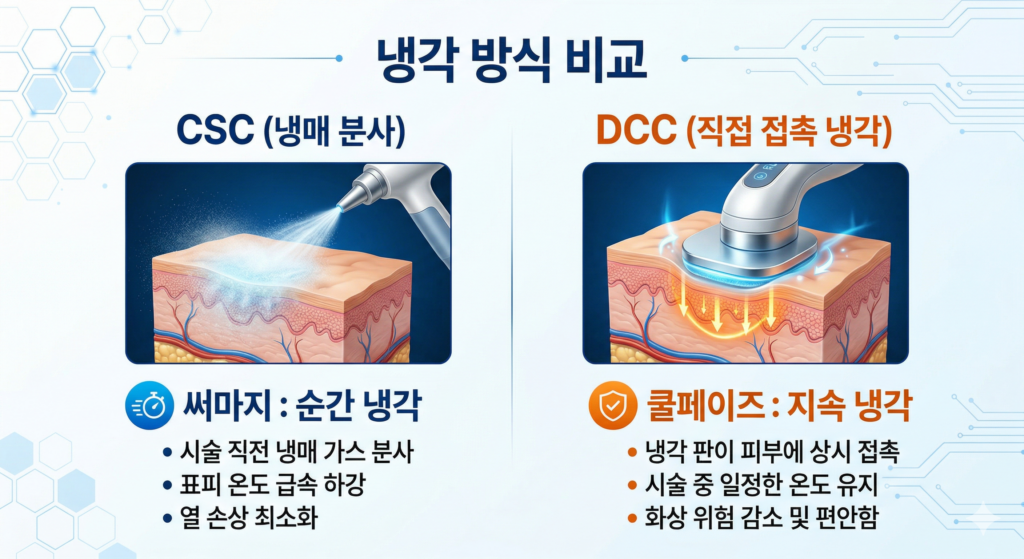
Thermage FLX is Cryogen Spray Cooling (CSC) methodwrite.
It's a way to lower the surface temperature of the skin by spraying a cold gas with a “puff” just before the tip touches.
This method is a time-tested technology, but due to its spray application, cooling is instantaneous, and if the tip is even slightly lifted from the skin, the heat distribution can become uneven.
So, Thermage works by fixing the tip to the skin and shooting shot by shot in static mode.
Coolphase completely changed its approach here.
Built-in cooling device in the tip itselfSo, it uses Direct Contact Cooling (DCC), which directly cools the surface the moment the tip touches the skin.
Without refrigerant gas, cooling is maintained as long as the skin and tip are in contact.
It's a difference like this, to use an analogy.
Thermage's cooling is like briefly running cold water over your hands before picking up a hot pot.
The cooling phase of CoolPhase is holding the pot with cooling gloves on from the start.
This difference can affect pain, the uniformity of energy transfer, and consequently, the effectiveness.
[Director Kim Young-kyun's Comment]
In South Korea, there are several types of Monopolar RF devices, including Thermage FLX, CoolFacing, Ulthera, and Voluwner. They all use the same principle of ‘monopolar radiofrequency,“ but each differs in its cooling design and energy delivery method. Instead of one device being ”absolutely better," the key is to understand the principle and choose the one that suits your skin.
📝 One-line summary: Thermage and CoolPeel use the same monopolar RF engine, but different cooling systems. This difference significantly alters the pain and treatment experience.
Is the difference in pain really that big? — Let's compare with clinical trial data.
To get straight to the point, when I shot with the same intensity, the pain was reduced by almost half.
Let's first address why high-frequency lifting is painful.
Why does high-frequency lifting hurt?
Monopolar RF is a procedure that creates heat within the skin.
For collagen to react, the temperature inside the skin must rise to at least 42-45°C.
The problem is that when heating the skin's interior, the epidermis also heats up.
Most of the pain we feel comes from this epidermal heat sensation.
If cooling sufficiently protects the epidermis, the pain is reduced.
If cooling is uneven or instantaneous, the epidermis is exposed to heat for a moment, which causes pain.
This is why the cooling method determines the level of pain.
What is the pain score measured in actual clinical practice?
There have been clinical trials that actually compared this.
At Severance Hospital, 22 women aged 38-50 underwent a procedure. One cheek was treated with water-cooled monopolar RF (a technology in the same family as CoolPeel), and the opposite cheek was treated with Thermage FLX. Each side received 300 pulses at the same power setting (65W). Reference: PMC Severance Clinical Trials
The results of the 10-point pain scale were as follows.
| Viewpoint | Watercooling method (Coolphase series) | Refrigerant injection method (Thermage FLX) |
|---|---|---|
| 100 shots | 3.1 | 5.8 points |
| 200 shots | 3.8 points | 7.4 |
| 300 shots | 4.5 stars | 8.4 points |
Around the 300-shot mark 46% difference.
Notably, while the pain from Thermage increased significantly with accumulated shots (from 5.8 to 8.4), the Coolpeel series showed a more gradual increase (from 3.1 to 4.5).
We often see this pattern in real clinical settings as well.
Among those who receive Thermage 600 shots, it's common for people to lower the energy because they can't tolerate the last 200 shots.
If you lower the energy, the effect will naturally decrease.
There are quite a few people who get cool sculpting procedures without anesthetic cream.
Of course, there are individual differences, so it's difficult to say it's “painless,” but in many cases, the procedure is maintained with a relatively constant, warm sensation throughout.
[Director Kim Young-kyun's Comment]
This actually happened in my clinic. Mr. Lee (a pseudonym), a man in his early 40s who works in an office, said he “could never do it again” even with sedation during his Thermage treatment. However, six months later, he switched to Coolpease, applied only a light numbing cream, and completed all 600 shots. His comment after the procedure was, “At this point, I could probably do it in my sleep.” Of course, his experience may not be the same for everyone, but there is definitely a difference in pain.
📝 One-line summary: With similar output standards, the pain difference is about 46%. Cool-phase series can often be performed without anesthesia.
Is it less painful and will the results be the same? — Comparing lifting, elasticity, and pore results
If I had to summarize in one sentence, the lifting effects are equal, and in terms of skin density and pores, the CoolPeel series actually performed better.
“If it doesn't hurt, isn't the effect weaker?”
I get this question a lot.
Intuitively, it's a natural question.
“This is because there's a perception that ”you only listen when you're in pain.".
However, the data doesn't always show that.
Is there a difference between lifting and elasticity equipment?
This is the result of an 8-week follow-up in the same Severance clinical trial. Reference: PMC Severance Clinical Trials
Looking at the ball lift angle.
__OPENROUTER_FAILED__.
Perioral lifting is also part of the CoolPeel series at 2.35°, and Thermage at 2.24°.
There was no statistically significant difference.
In simple terms, The lifting power for sagging skin was practically the same for both devices.means.
Skin elasticity (R2 value) is the same.
At the 8-week mark, both devices showed similar levels of improvement, and no significant differences were observed.
What were the differences in pore size and skin density?
Here's where it gets interesting.
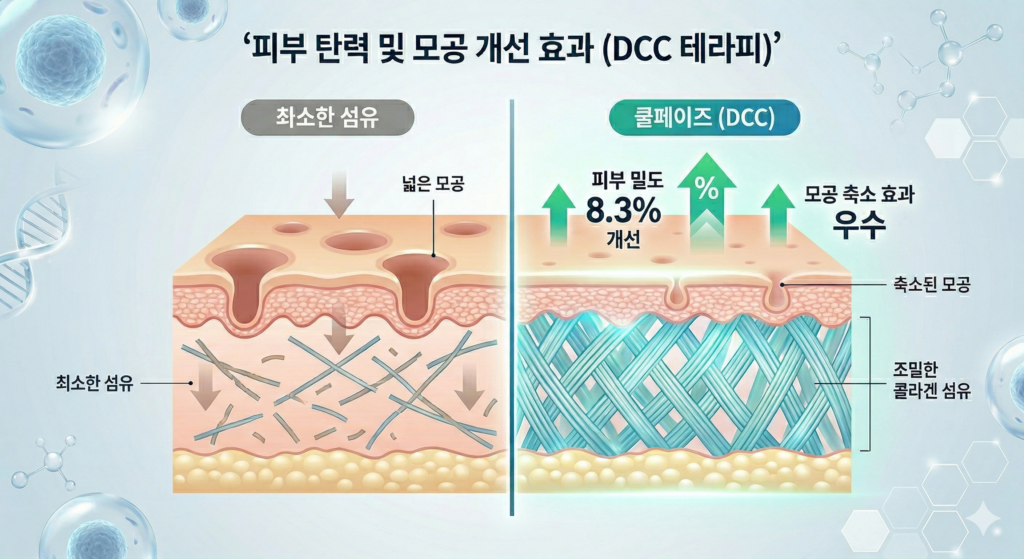
Skin density — CoolSculpting series 8.3% improvement vs. Thermage 6.6% improvement at 8 weeks.
A statistically significant difference (p<0.05) was identified.
Pore minimizing — Kulphase series showed significant superiority at 2, 4, and 8 weeks prior.
Based on an 8-week period, Cool-phase series: -15.4mm² vs Thermage: -9.2mm².
Why did this happen?
According to the research team's analysis, the DCC method is advantageous for delivering heat more uniformly throughout the dermis while protecting the epidermis.
The existing refrigerant spray method can lower the temperature of the superficial dermal layer (papillary dermis) just below the skin surface along with the rapid cooling of the skin.
To put it simply, it's like this.
Refrigerant injection is like briefly placing ice on a frying pan – the surface cools down instantly, but it can be difficult for the effect to penetrate deeply.
Direct contact cooling involves placing a cooling plate beneath a frying pan, which maintains a constant surface temperature while allowing internal heat to rise steadily.
Additionally, ex vivo (skin tissue experiment) results from the same study confirmed that water cooling significantly restored the density of Type I and Type III collagen proteins and elastic fibers (fibers that hold the skin taut).
__OPENROUTER_FAILED__.
In this study, VoluMeir (RF-CWC) was directly compared to Cool-Face (DCC), and although it has technical similarities to Cool-Face (DCC), it is not exactly the same equipment.
Large-scale, long-term follow-up studies on Coolphase itself are still needed.
[Director Kim Young-kyun's Comment]
“There's a common misunderstanding that strong cooling diminishes the effectiveness of treatment. It's actually the opposite. The more stable the protection of the epidermis, the higher the energy a doctor can safely deliver. It's also important that patients are less likely to ask for reduced energy due to pain, allowing the treatment to maintain optimal output from beginning to end.
📝 One-line summary: Lifting and elasticity are equal, while CoolPhase systems lead in clinical results for skin density and pores — the misconception that “if it doesn't hurt, it's not effective” is contrary to the data.
Would Thermage or CoolPeel be better for my skin?
To get straight to the point, it's not about “which equipment is superior,” but rather “which equipment is right for my situation.”.
Who is more suitable for Thermage?
Thermage FLX is a device with over 20 years of accumulated clinical data. Reference: Thermage Official
This long history itself becomes a basis for trust.
If the following applies to you, Thermage may be a better fit.
For those who can tolerate pain and desire significant results from a single treatment.
Thermage is a device accustomed to delivering high energy intensely at once, and for the practitioner, extensive experience and established protocols are in place.
Those who want eyelid (eye tip) procedures.
Thermage FLX has a separate tip specifically for the eye area, and there is extensive accumulated data on improving sagging of the upper eyelids.
For those who have already received Thermage and did not experience significant discomfort from the pain.
If you were already satisfied, there might be no reason to change.
Who is Cool Phase more suitable for?
On the other hand, if the situation were as follows, Cool-Phage could be a better option.
For those who are sensitive to pain or have previously given up on high-frequency lifting due to pain.
As mentioned earlier, approximately 46% lower pain levels were confirmed in clinical settings. A significant number of patients also receive treatment without anesthesia.
Someone who wants to receive it during lunchtime and return immediately.
Downtime is virtually nonexistent, and redness typically subsides within a few hours. Reference: NAISS Clinic Coolfase
Those who prioritize improving pores and skin texture.
Given that the indicators for skin density and pore reduction were significantly superior in the clinical data, it is suitable for those who wish to improve not only elasticity but also skin texture.
Can the two devices be used together?
Yes, it is possible.
High-frequency (RF) lifting targets the dermis layer of collagen, while ultrasound (HIFU) lifting targets the deeper fascial layer (SMAS).
Since the depths of action are different, you can manage both the surface and the inside of the skin simultaneously by addressing dermal elasticity with CoolPHAZE and supplementing deep lifting with HIFU treatments like Ultherapy or Shurink.
However, rather than performing both procedures on the same day simultaneously, it is safer to allow a 2-4 week interval between them while monitoring your skin condition.
It is best to consult directly with the director to determine the exact merger plan.
And one more thing.
During seasonal changes like this, the skin can become temporarily dry after a procedure.
Especially in spring in Korea, fine dust combines with dry winds.
For about a week after the procedure, pay extra attention to moisturizing and diligently apply sunscreen with SPF 30 or higher to help maintain the effects for a longer period.
[Director Kim Young-kyun's Comment]
To be honest, I really don't like saying, “This equipment is unconditionally good.” Every patient's skin thickness, degree of sagging, pain sensitivity, budget, and daily schedule are all different. There's something I always tell my patients during consultations: “Don't choose the equipment; tell me about your situation first. Then I will choose the right equipment for you.”
📝 One-line summary: Thermage is proven strength, Coolps is comfortable strength—approach it not as “which is superior,” but as “what is right for my situation.”.
Why do high-frequency lifting results vary between clinics?
To get straight to the point, the difference in how equipment is *used* is far greater than the difference in the equipment itself.
Even when using the same coolpeel or the same thermage, the results can vary from one clinic to another.
This is not a problem with the equipment.
It's a matter of setup and operation.
Why are genuine tips and energy settings important?
First, Whether to use genuine tips.
Monopolar RF equipment uses tips (cartridges) as consumables.
Genuine tips are precisely calibrated for energy transfer and cooling performance, a standard that non-genuine tips cannot guarantee.
The difference of one tip can completely change the result of the procedure.
Second, Shot interval and energy level settings.
This part is really important.
In the ex vivo experiment of the previously introduced clinical trial, collagen recovery was best when the interval between shots was maintained at 25 seconds, and conversely, collagen synthesis was inhibited when shots were fired quickly at 1-second intervals. Reference: PMC Severance Clinical Trials
Simply put, it's not about “shooting a lot, quickly, and being good.”.
Energy should be delivered at appropriate intervals, allowing the skin to cool down and have enough time to recover, to maximize its effectiveness.
“More shots are always better” is also a common misconception.
Whether it's 300 shots or 600 shots, what's important is whether each shot was delivered with the appropriate energy, at the right intervals, and to the correct location.
Why must the director perform the procedure personally?
The outcome of monopolar RF treatments is determined by the angle at which the tip is placed on the skin, the pressure applied, energy adjustments for each area, and the ability to read patient responses in real-time.
You can't use the same energy level on the thick fat area below the jawline and the thin skin under the eyes.
The settings for someone with full cheeks and someone with sunken cheeks cannot be the same.
Such fine adjustments are possible when a dermatologist directly holds the tip and performs the procedure.
“We would like you to understand that ”performed directly by the director" is not just a marketing slogan, but a factor that actually affects the results.
[Director Kim Young-kyun's Comment]
There are three important questions to ask during a consultation: “Are these genuine tips?”, “Does the director perform the procedure themselves?”, and “How is the energy setting determined?”. If a hospital can answer these three questions specifically, I believe you can trust them.
📝 One-line summary: Genuine tips + appropriate shot spacing + direct procedure by the director – these three factors significantly influence the results more than the equipment brand.
When should I get a coolphase and how long does it last?
In conclusion, you can feel the change with just one use, but repeating it 2-3 times makes it last longer.
How many sessions do I need?
Many people feel an improvement in skin elasticity after just one treatment.
However, depending on your skin condition and improvement goals, repeating the treatment 2-3 times at intervals of 1-3 months can lead to cumulative collagen regeneration for firmer and longer-lasting results.
How long do the effects last?
New collagen begins to be actively produced within the skin starting 2-4 weeks after the procedure.
The peak effect is usually reached in 2 to 3 months.
It is known to last for 6 months to a maximum of 1 year, and regular maintenance procedures every 6-12 months will help you maintain a consistent condition. Reference: NAISS Clinic Coolfase
For reference, there is data indicating that the effects of Thermage FLX appear gradually over 3-6 months and last for 12-24 months. Reference: Dr Plus Clinic Singapore
Q3. Is it possible to resume daily activities immediately after the procedure?
Yes.
Cooler phase is a non-invasive procedure, so there is almost no downtime.
Slight redness (erythema) or mild swelling (edema) may appear immediately after the procedure, but they usually subside naturally within a few hours.
Makeup is also possible from the first day.
However, it is recommended to avoid saunas, steam rooms, strenuous exercise, and alcohol for about a week after the procedure.
Paying attention to moisturizing and sun protection will help you maintain the effects for longer.
[Director Kim Young-kyun's Comment]
To be perfectly honest about the duration of the effects, no matter what radiofrequency equipment you use, a procedure alone cannot completely stop aging. It's helpful to have realistic expectations by thinking of radiofrequency lifting not as a procedure that “turns back time,” but rather one that “slows down the aging process.”.
📝 One-line summary: Noticeable change after one treatment, cumulative effect with 2-3 repetitions — peak effectiveness in 2-3 months, maintenance for 6-12 months + periodic management recommended.
Cool Phase FAQ
If you are considering CoolHair or high-frequency lifting in Apgujeong, we strongly recommend consulting with a dermatologist for a 1:1 personalized consultation before the procedure. This is because even with the same equipment, the results can vary depending on who sets it up and how it is set up.
At Core Dermatology, Director Kim Young-kyun, with 15 years of experience as a dermatologist, directly handles everything from consultations to procedures, aiming for a personalized approach that considers each patient's skin condition and lifestyle.
Don't just pick based on reviews or the low price. It's not too late to decide after a thorough consultation with a specialist who will examine your skin.
Thank you for reading the long text.
Sincerely, Kim Young-gyun, Chief Director of Core Dermatology
Scales of justice Legal Notice This article is for medical information purposes only and does not guarantee the effectiveness of specific procedures. Procedure results may vary depending on the individual's skin condition, age, lifestyle, etc. For accurate diagnosis and treatment planning, please consult directly with a medical professional at a healthcare institution. This content has been prepared in accordance with Article 56 of the Medical Service Act and its Enforcement Decree.
📚 References
- Comparative Analysis on the Efficacy of Monopolar Radiofrequency With Continuous Water Cooling and Conventional Cryogen Spray Cooling in Facial Rejuvenation — PMC
- Coolfase Product Page - Asterasys Official
- Coolfase Official Brand Site
- Introduction to Coolfase — NAISS Clinic
- HIFU vs. RF vs. Thermage Comparison — Dr Plus Aesthetics Clinic Singapore
- Thermage Official Website
- MFDS Medical Device Information Portal


 한국어
한국어  English
  日本語
日本語  简体中文
简体中文