
Apgujeong Ondarifting, the Same Machine, Different Results - A Complete Guide to Customized Treatments for Different Face Types

✍️ Kim Young-gyun | Director of Core Dermatology and Plastic Surgery, Dermatologist (License No. 106824)
📅 March 26, 2026 | 🔬 Based on clinical experience + academic resources
✅ Conclusion first
Pressotherapy is a non-surgical lifting that selectively targets the dermis and fat layer without damaging the epidermis with 2.45 GHz ultrashort waves, requiring a combination of 3mm-7mm handpieces depending on the face shape and degree of sagging, with results fully visible in 4-8 weeks and lasting 6-12 months depending on individual differences.
📌 The core of this article
- Ondarifting uses a fundamentally different energy delivery principle than RF (radiofrequency) and HIFU (ultrasound), with approximately 801 TP3T of microwave energy selectively absorbed by the fat layer.
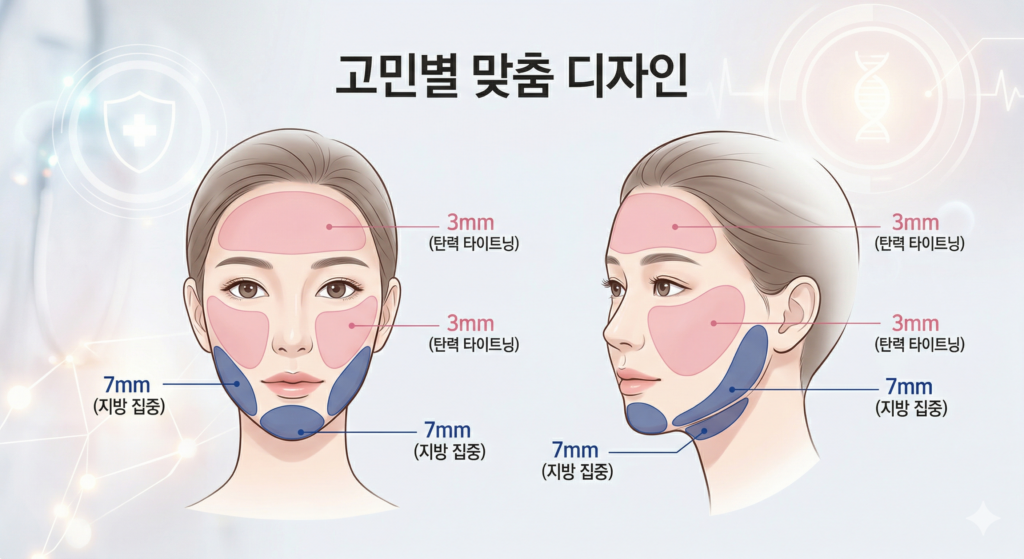
- 3mm handpiece remodels dermal collagen (firming - fine lines), 7mm handpiece reduces subcutaneous fat (contouring - double chin) - combinations vary depending on face shape
- Mild sagging can be improved with Onda alone, but moderate to severe sagging should be considered for a combined procedure such as Skin Booster-Lifting.
- Immediate tightening immediately after treatment → Collagen remodeling is complete after 4-8 weeks → Maintenance period of about 6-12 months (depending on the individual)
“Dr. Wong, I don't have a natural jawline, will that change if I get an ondialift?”
“My cheeks are sagging and my nasolabial folds are deepening, and I don't know if I should do Thermage or Onda.”
“Everyone says it's great on YouTube, but honestly, I'm not sure if it works for my face.”
Hello. This is Kim Young-gyun, CEO and Director of Core Dermatology.
These are questions we hear almost every day in the clinic.
Apache on-device lifting has been really popular lately,
We've gotten a lot more people asking, “Will this work for me?”.
The bottom line is that pressure point ondolifting is not a one-size-fits-all procedure.
The handpiece selection and energy settings should be completely different depending on the face shape, cause of sagging, amount of fat, and skin thickness.
Today, we're going to answer that question in detail.
1. How does thumbtack on-leg lifting work differently from other lifting?
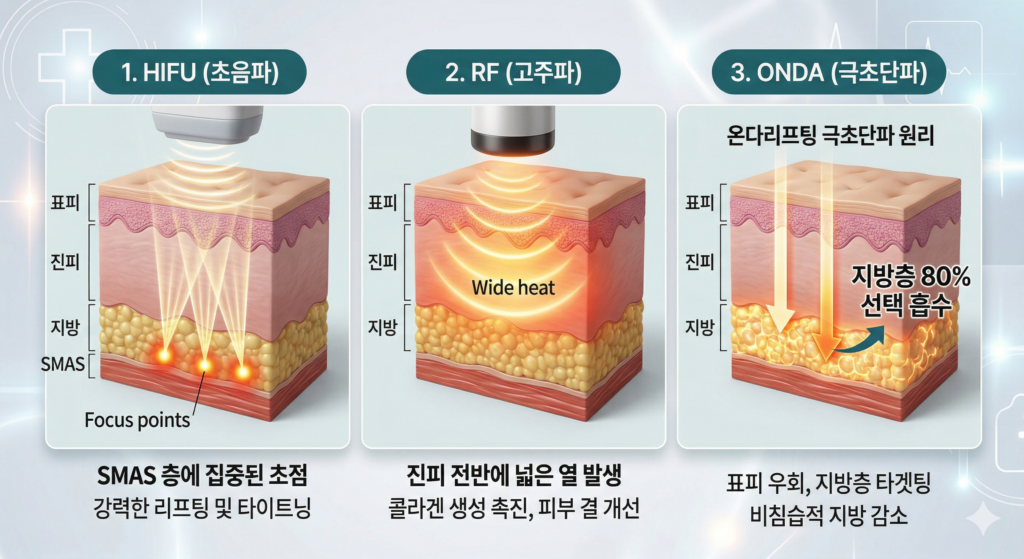
To summarize, acupuncture on-demand lifting uses microwave (Microwave), which is different from ultrasound (Ulthera) and radiofrequency (Thermage) because of the way the energy travels through the skin.
Many people think of tack on leg lifting as “laser lifting,” but it's not technically a laser.
Onda is a medical device developed by the Italian company DEKA that uses microwave energy at a frequency of 2.45 GHz. See also: DEKA ONDA PRO Official.
This is important because.
The more traditional Ulthera (HIFU, ultrasound) focuses energy on the SMAS fascia layer, while Thermage (RF, radiofrequency) heats the entire dermis over a wider area.
Onda's ultrasound waves, on the other hand, have about 801 TP3T of their energy selectively absorbed by the subcutaneous fat layer, with the remaining 201 TP3T acting on the dermis. See: PMC - Microwave System for Localized Adiposity.
To put it simply, it's like this.
Whereas Ultherapy is a procedure that tightens the “skeleton” under the skin, Thermage is a procedure that tightens the “outer layer”.
Onda is a procedure that reduces the “fluff” in between, while simultaneously tightening the outer fabric.
And the key is that there is almost no energy loss at the epidermal layer,
RF has difficulty reaching the deeper fat layers because much of the energy stays in the epidermis-dermis, and there is a risk of thermal damage to the skin's surface.
Because ONDA's ultrasonic waves almost “penetrate” the epidermis and work directly on the fat layer, there is a lower risk of superficial burns and significantly less pain See also: Kelly Oriental Aesthetic - ONDA Pro Guide.
This is because the cooling system built into the handpiece continuously reduces the epidermal temperature during the procedure,
It's so relaxing that most visitors describe it as “like a warm massage”.
[Director Kim Young-kyun's Comment]
“This energy delivery method is the reason why it's called ‘painless lifting.‘ We often have people who were hesitant about Ulthera because of the pain, and when they experience Onda, they ask, ’Is this a lifting?” And it is. It's just a different layer of energy working, but the end goal of remodeling collagen is the same."
One-line summary: Apgujeong Ondarifting is a non-surgical lifting that penetrates the epidermis with ultrashort waves and selectively acts on the fat and dermis layers, and the energy principle is different from Ulthera-Surge.
2. 3mm handpiece vs. 7mm handpiece, which one should I use for my face?
To be precise, the 3mm handpiece focuses on collagen contraction and regeneration in the dermis, while the 7mm handpiece reaches the subcutaneous fat layer for fat reduction and contouring.
There are two main handpieces for thumbtacks on-demand.
(There are three Pocket-Shallow-Deep in the ONDA PRO standard, but the ones I use most for facial procedures are 3mm and 7mm).
The 3mm handpiece (Pocket) has a shallow depth of action, delivering energy to the dermis layer in a concentrated manner See also: BeautiskyIntl - ONDA PRO.
The collagen fibers immediately contract to produce a tightening effect, followed by a gradual improvement in skin elasticity as new collagen is produced.
Ideal for those looking to reduce forehead wrinkles, crow's feet, improve overall skin texture, and shrink pores.
The 7mm handpiece (Shallow) allows energy to reach beyond the dermis into the subcutaneous fat layer.
It reduces fat by destroying fat cell membranes, but it also induces collagen remodeling. Reference: The Hera Clinic - ONDA Pro Singapore.
It is often used for double chins, fat under the chin, and excessive cheek volume.
But here's the most important point.
To be honest, there are very few “procedures that use 1001 TP3T in 3mm” or “procedures that use 1001 TP3T in 7mm”.
In the real world, we switch handpieces for different areas of the face, even within the same patient.
For example, let's take the case of Ms. A (a pseudonym), a woman in her late 30s.
Her main concern was a double chin, but she also had a lot of loss of elasticity around her eyes.
Fat reduction was induced with 7mm under the chin and jawline, and collagen tightening was performed with 3mm in the eye area and forehead.
We were able to address both concerns in one visit.
This is one of the biggest advantages of Apache on-delegation.
Because you can switch the depth of action and target organization just by changing the handpiece.
[Director Kim Young-kyun's Comment]
“There's an analogy I often use with my patients: think of 3mm as ‘ironing’ and 7mm as ‘flattening,” and it's the ratio of the two that makes the difference in the outcome. If you use too much 7mm on someone with very little facial fat and just loose skin, it can make the cheeks look off, and if you use 3mm on someone with a lot of fat, the lifting effect may not be as good as it could be, so palpation and visual assessment before the procedure is essential."
One-line summary: In most cases, you will use a different combination of the two handpieces within the same face for different areas - 3mm for firming and fine lines (dermis layer), and 7mm for fat reduction and contouring (fat layer).
3. Jawline collapse, cheek sagging, double chin - is the treatment different for each concern?
The bottom line is that the same acupuncture on-demand treatment can have completely different handpiece ratios, energy settings, and treatment movements depending on the area of concern.
We'll organize them by the four most common types of pain points we see in the clinic.
Type ① Jawline collapse (when the jawline is blurred)
The most common cause of jowls is a combination of increased subcutaneous fat around the chin and decreased skin elasticity.
In this case, the approach is to first reduce fat from the jawline down to the base of the ear with the 7mm handpiece, and then contract the collagen in the skin above the jawline with the 3mm.
Type ② Cheeks + Nasolabial folds
This is when the cheeks spill downward, deepening the nasolabial folds.
This type can look older by simply reducing fat, which can turn off the cheeks and make you look older.
The strategy of “pulling the cheeks into place” by contracting the dermal collagen from the upper cheeks to the cheekbones with the 3mm handpiece is the priority, with the 7mm only partially combined if there is thick fat in the lower cheeks.
To determine this properly, palpation is key.
If the thickness of your cheek is more than 1.5 centimeters when you pinch it with your finger, you have a high percentage of fat, and if it's less, it's often due to loss of elasticity.
Type ③ Double Chin
“I've lost weight, but my double chin hasn't gone away,” many people say.
The double chin is the area where the fat reduction effects of the 7mm handpiece are most directly felt, as this is where subcutaneous fat is concentrated under the chin.
But let's clear up one common misconception here.
“You might be thinking, ”If I shoot energy harder, it will work better," but that's not the case.
A skinfold test measurement of at least 2 cm but less than 5.5 cm confirms the effectiveness of the procedure. See: PMC - Microwave System for Localized Adiposity, If you put too much energy into an area where the fat is too thin, it will only cause unnecessary irritation.
Type ④ Overall stretched feeling (mild to moderate relaxation)
The entire face feels more “droopy” than certain areas.
This is the type of person we hear a lot from in their late 30s and early 40s.
For these individuals, a 3mm handpiece works well, with an evenly distributed treatment across the face, and a 7mm handpiece around the jawline and corners of the mouth.
[Director Kim Young-kyun's Comment]
“In fact, for tumescent on-demand lifting to be a ‘personalized treatment,” the pre-treatment diagnosis is more important than the device itself, because the same 40-something woman can have the exact opposite handpiece proportions depending on whether she has fatty or laxity-based sagging. A treatment that just shoves the same settings on everyone without proper consultation is, quite frankly, pouring water on the poison."
One-line summary: Jawline - 7 mm specific gravity for double chin, 3 mm specific gravity for nasolabial folds, 3 mm major + 7 mm minor for total laxity - the key is accurate diagnosis before the procedure.
4. Is an Onda lift sufficient, or is a merger procedure necessary?
In a nutshell, mild sagging can be improved with Onda alone, but if you have moderate or more severe sagging or volume loss, a combined procedure is much more effective.
Thumbtack ondrafting is a great procedure.
But it's not a one-size-fits-all solution.
I think it's important to be honest about this,
Depending on the degree of sagging, we'll distinguish between cases where onda alone is sufficient and cases where it is not.
When Onda alone is enough to get excited about
For early sagging in the late 20s to mid-30s, or “what you see in the mirror,” you can expect satisfactory improvement with Apaguete On-Lift alone.
This is because at this stage, the collagen remodeling alone still has room to tighten the skin again.
If you need to review your merge procedure
You are over 40 years old or have a decrease in cheek volume that makes you feel “off”,
Or, if your nasolabial folds have deepened to the point where they cast a shadow, you can use the
Using Apache on-delegation by itself may not meet your expectations.
Treatments that are often combined in these cases include replenishing dermal hydration and elasticity with skin boosters (Lizuran, JUVELUX, etc.), adding volume with collagen boosters (Olidia, etc.), and physical lifting with thread lifting.
This is especially true during the dry season in Korea (fall to early spring), when skin barrier damage and moisture loss accelerate, and collagen breakdown accelerates.
If you're only getting Apgujeong Ondarifting and neglecting your skincare during this time, the results may be short-lived.
How long it lasts depends on how diligent you are about moisturizing and sun protection after the procedure,
It's important to remember.
[Director Kim Young-kyun's Comment]
“I categorize sagging into three stages: if it's ‘visible in photos‘, I recommend Onda alone; if it's ‘noticeable to others”, I recommend Onda + Skin Booster; and if it's 'uncomfortable in your daily life', I recommend Onda + a lifting or surgical consultation. It's not necessarily a combination of the most expensive treatments, but rather finding the right combination for the stage of sagging you're at."
One-line summary: Consider additional treatments: early sagging → Onda alone, moderate sagging + volume loss → Onda + Skinbooster combined, severe sagging → lifting - the right combination for the stage is key.
5. When will I see results after the procedure and how long will they last?
To be more precise, tumescent on-demand tightening occurs immediately after treatment, with collagen remodeling taking 4-8 weeks to complete, and the duration of results is approximately 6-12 months depending on the individual.
“Will I see results the same day I have the procedure?”
I get this question a lot.
The answer is “yes, to a certain extent”.
Immediately after the procedure, the collagen fibers contract with heat, resulting in an immediate tightening effect.
Many of us can look in the mirror and immediately notice a slightly refined jawline.
But the real game is after that.
Over the next four to eight weeks after the procedure, your skin will become increasingly firmer as new collagen is produced,
This is the time when most people realize, “Oh, that's definitely different” See also: Illuminate MediSpa - ONDA Pro.
The length of time will vary.
The range of clinical experience and literature to date is approximately 3-6 months for a single treatment and up to 8-12 months after three intensive treatments one month apart.
To summarize the recommended protocols.
Three one-month intervals for an initial intensive phase, followed by one maintenance treatment every three to four months for long-lasting results.
Protocols from Singapore-European clinics also recommend 4-6 sessions, spaced 2-4 weeks apart, so there is not much difference between domestic and international standards. Reference: U Aesthetics Singapore - ONDA Pro Guide.
Post-procedure precautions
You can wash your face, apply makeup, and go about your daily routine the day of your procedure.
However, for maximum effectiveness, we recommend keeping the following in mind.
Avoid strenuous exercise, saunas, and hot water for 24 hours after your procedure.
Lukewarm water is recommended. This is because the lingering warm feeling after the procedure actually helps remodel the collagen.
Gentle massage of the treated area for 3 days will help increase lymphatic circulation.
Most importantly, stay hydrated and use sunscreen See also: Illuminate MediSpa - ONDA Pro.
I'll be honest about the side effects.
Mild redness and warmth may occur immediately after the procedure, but usually disappears within a few hours.
In a clinical study of 35 people, no serious adverse events were reported, including pruritus, edema, burns, nodules, or blisters See: PMC - Microwave System for Localized Adiposity.
[Director Kim Young-kyun's Comment]
“I always tell my patients, ‘The 30 days after the treatment are more important than the 30 minutes during the treatment,’ because the treatment itself is not the end of the story, but the results depend on how diligent you are about moisturizing and sun protection over the next month while your collagen is remodeling.”
One-line summary: Immediate tightening → 4-8 weeks collagen remodeling complete → Maintenance 6-12 months (depending on individual) - 3 intensive treatments 1 month apart followed by maintenance treatments every 3-4 months is the recommended protocol.
6. What should I look for when choosing an Apgujeong Ondarifting hospital?
The bottom line is that the diagnostic ability of the doctor to read your face and put the handpiece together differently is more important than the authenticity of the equipment.
There's a lot of dermatology on a thumbtack.
There are more and more companies that are pursuing on-demand lifting,
If you're just looking for reviews and low prices, it can be hard to be satisfied.
Here's what you need to know.
First, DEKA Genuine Equipment or not.
Thumbtack on-leg lifting is a medical device that uses patented technology (Coolwaves) from DEKA, Italy See also: DEKA Headquarters.
In Korea, Cheongwoo Medical is in charge of official distribution, and you can check the certificate of authenticity. References: Cheongwoo Medical.
Second, In-person dermatologist or not.
Acupuncture on-demand is a procedure where results can vary depending on handpiece selection, energy settings, and procedure mobilization.
It's not just about moving the device across the skin, it's about making real-time judgments about skin thickness and fat mass.
Third, Make sure you have both 3mm-7mm handpieces You'll need to confirm.
Sometimes we only have one handpiece, and as I mentioned earlier, we need both to do a custom procedure.
Fourth, Ensure there is a full consultation and diagnostic process before the procedure.
Any place that jumps right into the procedure without palpation, assessing skin thickness, and checking fat distribution might want to reconsider.
[Director Kim Young-kyun's Comment]
“At Core Dermatology, I always consult with you before the treatment and design the handpiece ratio and energy settings for each facial area. Applying the same protocol to everyone is not ‘personalized,‘ it's 'one-size-fits-all.
One-line summary: Genuine DEKA equipment + Dermatologists on hand + Full range of 3mm-7mm handpieces + Personalized diagnosis before the procedure - these are the four key criteria for choosing an Apgujeong Ondarifting hospital.
Apgujeong On-Demand FAQ
If you're considering tack on leg lifting, we recommend a 1:1 in-person consultation with a dermatologist before your procedure to determine which handpiece combination is right for your face shape and level of sagging.
Don't just pick a place based on reviews and low prices, make sure you're getting a treatment plan that works for your face.
Thank you for reading the long text.
Sincerely, Kim Young-gyun, Chief Director of Core Dermatology
⚠️ Legal Notice This content is for medical information purposes only and does not guarantee the effectiveness of any specific procedure. Results may vary depending on the individual's skin condition, age, lifestyle, etc. and we recommend that you consult with a dermatologist before undergoing any procedure. Written in compliance with Article 56 of the Medical Act and the Medical Advertising Review Standards.
📚 References
- DEKA ONDA PRO Official Product Page
- BeautiskyIntl - DEKA ONDA PRO Product Information
- Kelly Oriental Aesthetic - Onda Pro Complete Guide (Singapore)
- U Aesthetics - Onda Pro Coolwaves Singapore Guide
- The Hera Clinic - Onda Pro Body Contouring Singapore
- Illuminate MediSpa - Onda Pro Face and Body Lift (Singapore)
- PMC - Microwave System: A Novel Treatment for Localized Adiposity Reduction (2023)
- Gangnam Natural Beauty - Melt Stubborn Fat with ONDA Lifting
- Cheongwoo Medical - ONDA / CONTLEX Formula


 한국어
한국어  English
  日本語
日本語  简体中文
简体中文