
3 Crucial Things You Miss When Comparing Apgujeong Radias Prices

✍️ Kim Young-gyun | Director of Core Dermatology Clinic · 15 years of experience as a dermatologist
📅 April 1, 2026 | 🔬 Based on clinical experience + academic resources
“Director, I'm looking into getting Radiesse in Apgujeong, but the dilution ratios and prices vary a lot from clinic to clinic. I don't know what criteria I should use to choose.”
✅ Conclusion first
Even when receiving the same radius treatment, some people will say, “My skin has completely changed” after 12 months, while others will say, “I just wasted my money.” The difference is not in the product, but in these three factors: ‘dilution ratio × injection depth × dermatologist's skill’. In this article, we will break down the criteria for each.
Hello. This is Kim Young-gyun, CEO and Director of Core Dermatology.
“They say that if you get a Radius treatment, your volume will naturally come back, but when you look for information, each hospital says something different, so I don't know who to believe.”
When I'm counseling people on Apgujeong Redeath, I get a lot of people who are confused by the different explanations for the same procedure at different hospitals.
Most reviews of Apgujeong RADIUS online are missing the most important point.
Today, we're going to fill in the blanks. By the end of this article, you'll be able to ask one question to determine the quality of any dermatology practice you visit. Here are the top 3 things to look for when choosing a dermatology clinic.
Is Apgujeong Radius a filler or a collagen booster?
To get straight to the point, Apgujeong Radius is both a filler and a collagen booster. However, the method most commonly used in dermatology clinics these days is much closer to a ‘collagen booster.".
This may be a bit confusing.
The main ingredient in Aphrodisiac Redis is calcium hydroxyapatite, or CaHA for short. It's a mineral that's naturally found in our bones and teeth. This CaHA is mixed into the gel in the form of very small granules (microspheres). Reference: Merz Aesthetics Singapore
When you inject, two things happen.
First, it immediately fills in areas where the gel has receded. This is the role of the filler.
Second, over time, the CaHA granules stimulate fibroblasts in the skin - in other words, they send a signal to “make new collagen.” Here's where it gets really different from other skin boosters: while most collagen boosters only produce type 1 collagen, which is the backbone of the skin, Apgujeong Redeemer's can also produce type 3 collagen, which is responsible for elasticity and smoothness. In addition, studies have shown that it also stimulates the production of fibers (elastin) and water-holding components (proteoglycans) that keep skin tight. Reference: Aesthetic Studio Singapore
So nowadays, rather than using them for ‘fillers’ to add volume, they are much more commonly used as ‘collagen boosters’ to improve skin quality itself.
[Director Kim Young-kyun's Comment]
“There are still quite a few people who only know Radius as a filler. If you only think of it as a ‘volume-adding procedure,‘ your expectations and results may not align. If you mention during the consultation, ”My goal is skin elasticity rather than volume," we can better determine the direction of the procedure.”
One-line summary: Apgujeong Redeath is a CaHA-based collagen booster that promises both immediate volume correction and long-term collagen regeneration.
Why does the dilution ratio of Apaguemaldehyde vary from hospital to hospital?
To be honest, it's a procedure where one dilution ratio can completely change the outcome, so it shouldn't be different from hospital to hospital, it should be normal.
Let me explain what this means.
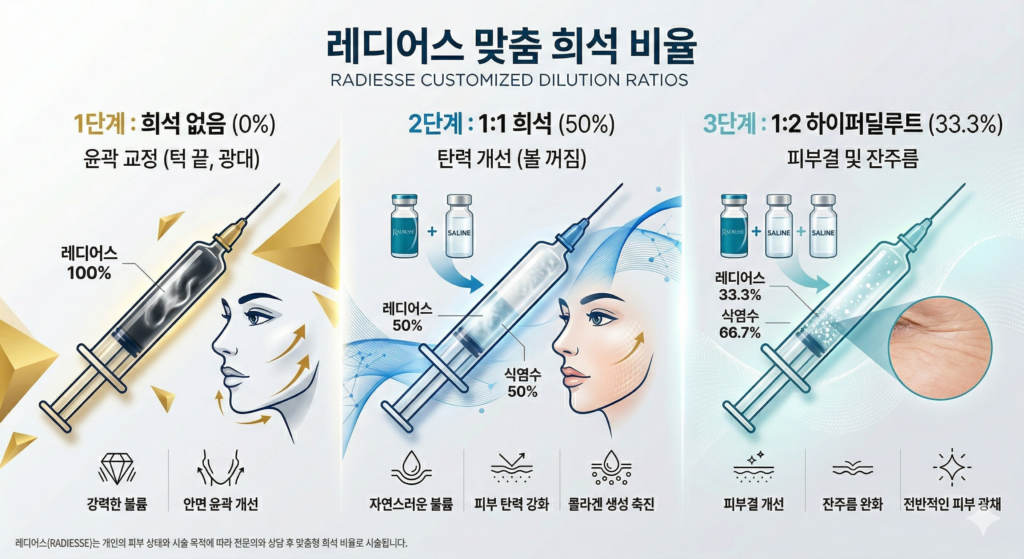
If you inject pure Radiance, you'll get a strong volume effect. This method might be suitable for areas that need structural definition, like the chin or cheekbones.
On the other hand, for areas where you want to improve skin elasticity and texture, such as under the eyes or nasolabial folds, we use a method of diluting saline solution with a local anesthetic and spreading it over a wide area. This is called ‘hyperdilute’.
According to the consensus reached by 12 Asian dermatologists, these are the criteria. Reference: Pan-Asian Consensus, J Clin Aesthet Dermatol 2021
For skin biostimulation (collagen regeneration induction), a 1:1 dilution is most common. For those with thin skin, dilute further to 1:2. For contouring purposes, it is not diluted or diluted very slightly.
Here's the really important point.
In expert consensus, it was emphasized that “dilution ratio and dosage are completely different concepts.” Diluting a lot does not mean less CaHA component is included. Diluting 1:2 triples the total injection volume but the actual amount of CaHA remains the same. Confusing this can lead to thinking, “Since it's diluted a lot, shouldn't it be cheaper?” but it's actually a completely different story.
So, during a consultation, it's good to ask, “What's the dilution ratio here?” but a more accurate question is this:.
“What is the dilution ratio appropriate for my skin condition? And what is the actual dosage of CaHA?”
A clinic that can answer this question clearly is at least a clinic that understands and performs tumescent redress.
[Director Kim Young-kyun's Comment]
“There isn't a single ‘correct” dilution ratio. Even on the same face, you often need to use different dilution ratios for the area below the cheekbones and the jawline. Honestly, applying the same ratio to the entire face is a rather regrettable approach."
One-line summary: The dilution ratio of Thumbtack Redress should vary depending on the purpose of the treatment and the thickness of the skin, and beware of ‘one size fits all" treatments.
How much will the results differ between cannula procedures and needle procedures?
The bottom line is that if you're going to regenerate pressor redox collagen, cannulas are the way to go, and it's not a matter of taste, it's a matter of safety.
A cannula is a long, tube-shaped insertion tool with a rounded tip. Unlike a regular needle, it carries a lower risk of puncturing a blood vessel.
But safety isn't the only reason why cannulas are important to the Apogee Redeemer.
According to the consensus results of Asian specialists, when injecting diluted Radiesse for collagen regeneration (biostimulation), it is recommended to use cannulas only. Needles are not used. Reference: Pan-Asian Consensus, J Clin Aesthet Dermatol 2021
What's the reason?.
The cannula can travel in a wide swath just below the dermis and spread the diluted CaHA evenly, similar to spreading seeds evenly in a field. The needle, on the other hand, is a dot, dot, dot, which can cause the CaHA to clump together in one place. This clumping can lead to nodules (hard lumps under the skin), which is the most common side effect of Acupuncture Redus.
Also, for the cannula procedure, 1 to 2 entry points (where the needle goes in) are sufficient. This can result in less bruising and swelling compared to puncturing in multiple places with a needle.
However, there are exceptions. Needles may be more suitable for areas that require precise placement in small amounts directly on the bone, such as the chin or cheekbones. This means it's important to be able to switch tools depending on the area.
[Director Kim Young-kyun's Comment]
“During a consultation, it's good to ask, ‘Do you use cannulas or needles for the procedure?’ Honestly, if the goal is collagen regeneration and they say they'll do the entire procedure with needles alone, I recommend double-checking. Of course, needles are sometimes necessary for specific areas, so a more accurate question is, ‘What tools do you use for each specific area?’
One-line summary: The use of cannulas in Radiesse collagen biostimulator treatments is the international expert consensus standard and is essential for preventing nodules and ensuring uniform distribution.
Why is a dermatologist's experience more important at Radiesse?
To get straight to the point, Radiesse is a procedure that relies much more on ‘the doctor's touch" than other injection procedures.
Hyaluronic acid (HA) fillers have an antidote (hyaluronidase) that can dissolve them if you don't like the results after injection. This means they can be reversed to some extent.
But Radius doesn't have that.
Since CaHA is slowly metabolized and broken down in the body, there is no dissolving agent once it is injected. While it is naturally absorbed over time, if the wrong amount is placed in the wrong location, it is not easy to correct.
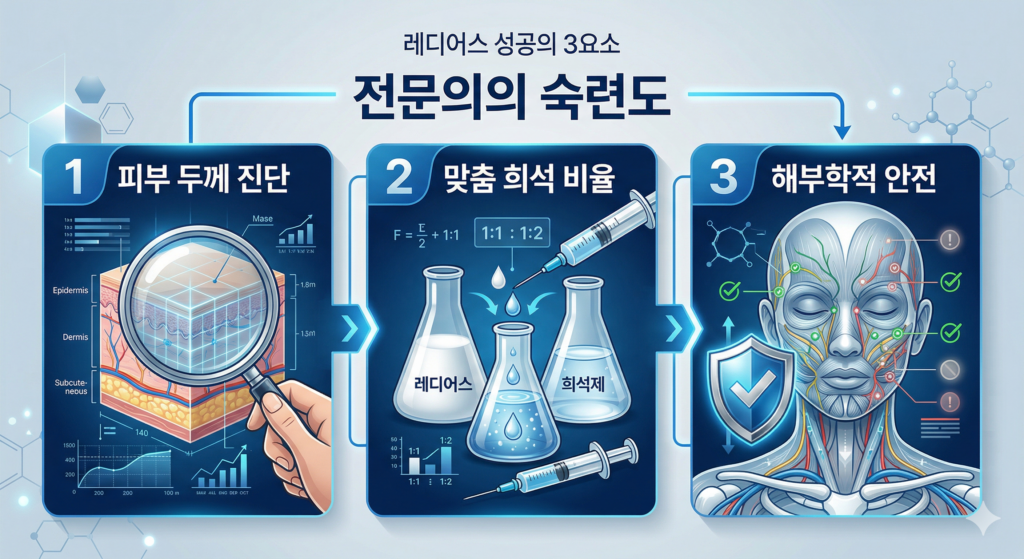
So with this procedure, three things have to be hit at the same time.
First, diagnostic skill to accurately identify skin thickness and fat layer. Even under the same cheek, skin thickness varies from person to person, and injecting the same ratio to someone with little fat will yield completely different results.
Second, the technique of adjusting the dilution ratio and injection depth differently for each area. As I mentioned earlier, performing the procedure on the entire face with a single ratio is difficult to consider a customized treatment.
Third, anatomical understanding of vascular pathways. The consensus among Asian specialists, in particular, agreed not to directly inject CaHA into the infraorbital area for safety reasons. Knowing and avoiding these contraindications accurately also comes from experience. Reference: Pan-Asian Consensus, J Clin Aesthet Dermatol 2021
When looking for a good place for Apgujeong Radius, this is what you should check first, rather than price or number of reviews.
“Are they a dermatology specialist, do they have sufficient experience with Radiesse procedures in Apgujeong, and do they have customized protocols for each area?”
[Director Kim Young-kyun's Comment]
“My approach to Radiesse has changed a lot from when I first started. As I gain more experience, I develop a sense for ‘this ratio is right for this skin thickness.” That changes after 100 or 200 cases. Honestly, Radiesse is a procedure that's difficult to confidently recommend without experience.”
One-line summary: Due to the irreversible nature of tack redress, the outcome depends on the skill of the dermatologist who is able to assess skin thickness, customize dilution for each area, and familiarize themselves with anatomical safety zones.
Is this all I need to know about post-treatment care for Aphthous Redness?
If I had to give you just one line, Radius's post-procedure 72-hour management can determine satisfaction more than the procedure itself.
Immediately after the procedure, you may experience slight swelling (edema), redness (erythema), or bruising. These are temporary reactions that usually subside within a few days.
However, you must be careful about a few things during this time.
For 3 to 7 days after the procedure, please avoid saunas, jjimjilbangs (Korean steam rooms), and hot baths. Applying heat can disrupt the CaHA distribution before it has a chance to settle.
You should also refrain from rubbing or massaging the treatment area vigorously. This is because the well-laid CaHA particles can be pushed to one side and become uneven. Reference: Cienna Medical Aesthetics Singapore
It's best to avoid alcohol for about three days. Alcohol can widen blood vessels, which might make bruises last longer.
And one of the things many people are curious about is “When will I start seeing results?”.
Immediately after injection, you may feel volume due to the gel ingredient. However, the real effect, meaning improved skin elasticity and texture through new collagen formation, will gradually appear over 4 weeks to 3 months. You need to wait at least 4 months to assess the full results. Reference: Pan-Asian Consensus, J Clin Aesthet Dermatol 2021
The duration of Apgujeong RADIANCE is subject to individual differences, but it is generally reported to be around 12-18 months. For Hyperdilute treatments with the purpose of collagen regeneration, it is common to repeat the procedure 2-3 times at intervals of 4-6 weeks, and afterwards, you can consider maintenance treatments once a year. Reference: Aesthetic Studio Singapore
[Director Kim Young-kyun's Comment]
“Some people say, ‘I don't think it's working yet‘ after 1-2 weeks of treatment. Radiesse is like that. It takes time for collagen to regenerate. Many people feel, ”Huh? My skin has changed' a month or two later. Please be patient and wait."
One-line summary: Avoid heat, pressure, and alcohol for 72 hours after the procedure. The collagen regeneration effect appears gradually over 4 weeks to 3 months, so it is recommended to observe the results for at least 4 months.
Can the Radiance be unsuitable for certain skin types?
To be honest, Radius isn't suitable for every part of the body or every skin type. In fact, a clinic that is upfront about this is a trustworthy one.
There is a specific area that is clearly designated as a ‘contraindication' in the consensus of Asian specialists.
It's the under-eye area (infraorbital region). This area has very thin skin and densely packed blood vessels, so there's a high risk of nodule formation or vascular problems if CaHA is injected directly. Reference: Pan-Asian Consensus, J Clin Aesthet Dermatol 2021
Also, for individuals with very thin skin and minimal subcutaneous fat (the layer of fat beneath the skin), using standard dilution ratios may increase the likelihood of nodule formation. In such cases, it is appropriate to recommend a higher dilution ratio or an entirely different procedure.
Here are three frequently asked questions:.
A. Yes, Radiesse can be injected into areas where you have previously had fillers or Botox.
There are many possibilities. However, depending on the type of existing filler and the injection site, the interval may need to be adjusted, so you must inform us of your previous procedure history during your consultation.
Q. What should I do if a nodule (lump) forms with Apgujeong Radiance?
Since CaHA doesn't have a dissolving agent like hyaluronic acid, you have to wait for natural absorption or manage it with steroid injections. Therefore, ‘prevention' to avoid nodule formation is most important, and this depends on the dilution ratio mentioned earlier, the use of cannulas, and the proficiency of the specialist.
A. Yes, Radius can be used for neck wrinkles.
While it is possible to use diluted Radiesse for neck biostimulation, the neck requires more precise techniques than the face due to its thinner and more mobile skin. The consensus among Asian specialists also recommends that neck procedures must be performed with a cannula, injecting into the superficial subdermal layer (above the platysma muscle).
[Director Kim Young-kyun's Comment]
There are definitely skin types or areas where Radius isn't suitable. I recommend choosing a place that honestly says, ‘Rather than ‘We can do anything,” it would be better to get a different procedure for this area."
One-line summary: The under-eye area is a contraindication for CaHA injection. If the skin is very thin, adjustments to the dilution ratio or alternative procedures should be considered. A consultation with a specialist is required before the procedure.
Apgujeong Radius FAQ
If you are considering Radius in Apgujeong, we strongly recommend consulting thoroughly with a dermatologist before the procedure to confirm your skin thickness, treatment goals, and appropriate dilution ratio.
At Core Dermatology, Head Physician Kim Young-gyun, a board-certified dermatologist with 15 years of experience, personally handles everything from consultations to procedures. We aim for a personalized approach tailored to each patient's skin condition and concerns.
Don't just pick based on reviews or cheap prices; please remember the three standards I've mentioned today.
Thank you for reading the long text.
Sincerely, Kim Young-gyun, Chief Director of Core Dermatology
⚠️ Legal Notice This article is intended for informational purposes only and is not intended to recommend any specific procedure. The effects of the procedure may vary depending on individual skin condition, health status, lifestyle, and other factors. It is essential to have a thorough consultation with a medical professional before undergoing any procedure. This post has been prepared in accordance with the medical advertising review standards under Article 56 of the Medical Service Act and its Enforcement Decree.
📚 References


 한국어
한국어  English
  日本語
日本語  简体中文
简体中文