
Alltight in Seoul, 5 Things You Need to Know Before You Get Your First One

✍️ Kim Young-gyun | Director of Core Dermatology and Plastic Surgery, Dermatologist (License No. 106824)
📅 03. 20. 2026 | 🔬 Based on clinical experience + academic data
✅ Conclusion first
Apgujeong All Tight is a non-surgical lifting procedure that selectively heats the mid-to-lower dermis to the SMAS layer at a low temperature of approximately 45°C using DLTD® dielectric heating technology to induce collagen recoil. After one treatment, the nasolabial fold depth decreased by 35.5% at 8 weeks, and a maintenance period of 6 months to 1 year can be expected with a series of 3 treatments spaced one month apart.
📌 The core of this article
Unlike existing HIFU and RF, Ulteight DLTD® selectively heats the dermis to SMAS using low-temperature dielectric heating.
• Average pain score in clinical study 0.4/10 — a level at which the procedure can be performed without anesthesia
• The energy absorption rate of the fat layer is 1/17th that of the dermis, structurally reducing concerns about sunken cheeks.
% 35.5% reduction in WSRS 8 weeks after the first treatment, with results expected to last 6 months to 1 year after a 3-treatment program.
Reading time: Approximately 8 minutes
“I want to get a lifting treatment, but Ultherapy is too painful... I'm worried about fat loss with Thermage... I've heard good things about Ultight in Apgujeong these days, but is it really okay?”
Hello. This is Kim Young-gyun, CEO and Director of Core Dermatology.
This is one of the questions I hear most often in my office recently.
Especially those who search for and come to Apgujeong All Tight have often already done some research on lifting procedures.
That's why, while they have high expectations, they also have concerns that it might be exaggerated.
Today, I'll honestly share 5 things that those considering Opulentite in Apgujeong for the first time should know before getting the procedure.
1. What's the difference between Apgujeong All Tight DLTD technology and existing lifting methods?
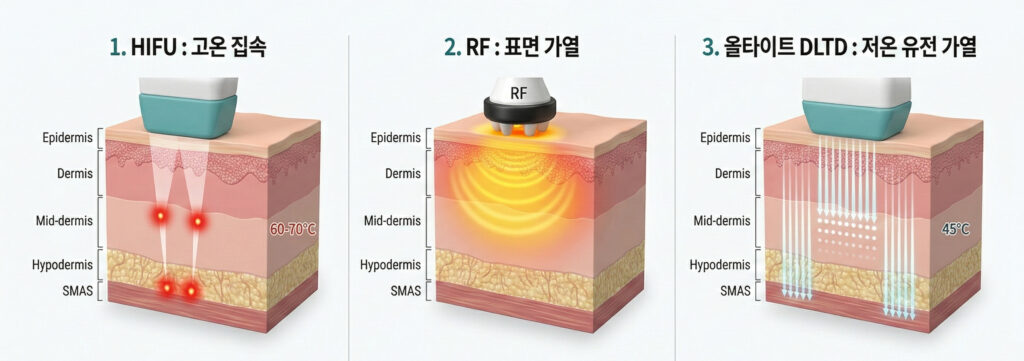
To get straight to the point, Apgujeong All Tight's method of delivering energy is fundamentally different from existing ultrasound (HIFU) or radiofrequency (RF) treatments.
This is important because.
When comparing lifting equipment, many people often only consider “which one is stronger,” but in reality, the key is “where and how the energy reaches the skin.”.
To put it simply, it's like this.
Ultherapy (HIFU) works by concentrating sunlight to a single point with a magnifying glass.
It concentrates intense heat of 60-70°C at point-like intervals on the SMAS fascial layer.
While the effect is powerful, the high temperature causes significant pain and there is a possibility that surrounding fat layers may be affected by the heat. Reference: ScienceDirect – DLTD Clinical Research
Thermage (RF) works by heating from the surface, like an electric blanket.
The temperature is highest at the dermo-epidermal junction, and the energy weakens as it goes deeper into the layers.
It's good for improving skin texture and light elasticity, but there may be limitations if you expect deep lifting.
What about All-Tight?
Alltite's DLTD® (Dermis Layer Targeted Dielectric Heating) uses a slightly different principle.
It's called dielectric heating. It's a technology originally used in cancer treatment and rehabilitation, applied to skincare. Reference: Innoxus Official
The core is this.
Leveraging the property that tissues with high water content absorb energy better, the dermis in the mid-to-lower layers and the SMAS layer, which are rich in water, are intensively heated, while the epidermis and fat layer, which have less water, are designed to be heated relatively less.
The temperature is also around 45°C, which is significantly lower than HIFU (60-70°C).
It is reported that collagen triple helices can begin to recoil (contract) within this temperature range, and with the activation of heat shock protein HSP-47, collagen regeneration can begin without irreversible damage. Reference: ScienceDirect – DLTD Clinical Research
For your reference, Alltight is a medical device developed by Innoxus, a domestic company, and is a product approved by the Ministry of Food and Drug Safety.
Abroad, it has already been exported to over 300 units in Japan, Hong Kong, Brazil, and other countries. Reference: Innoxus Official
[Director Kim Young-kyun's Comment]
“To be honest, all lifting equipment has its pros and cons. Apgujeong All Tight isn't a one-size-fits-all solution. However, for the purpose of wanting to deliver energy to the deep layers of the dermis while minimizing pain and discomfort, I believe DLTD technology offers a distinctly different approach compared to existing equipment.‘
📝 One-line summary: All-tight DLTD® selectively heats the dermis to SMAS using “low-temperature dielectric heating,” which is fundamentally different in principle from the high-temperature focused heating of HIFU (Ultherapy) or the surface heating of RF (Thermage).
2. Is Apgujeong All-Tight Lifting really painless?
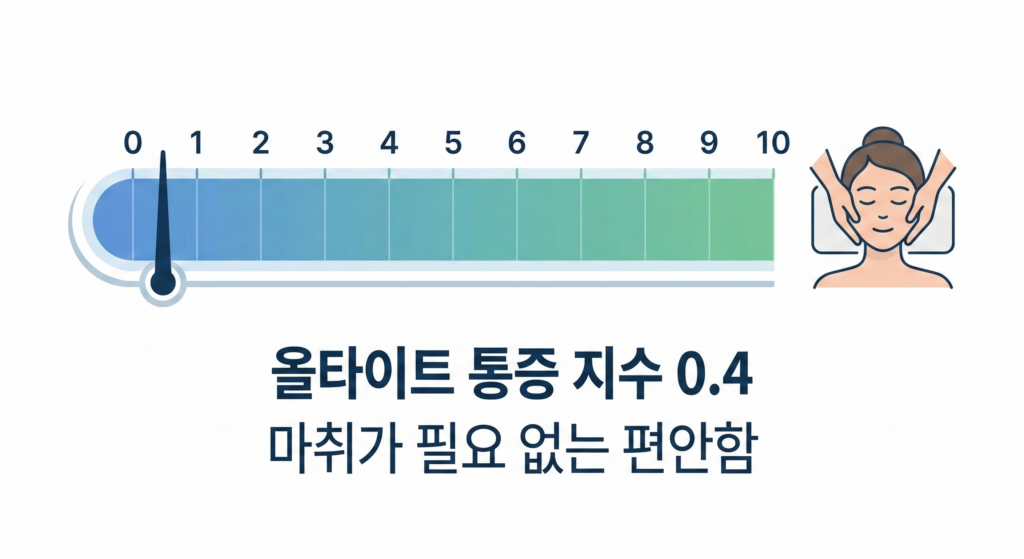
In a clinical study published in 2026, the immediate post-Oltype procedure pain score was an average of 0.4/10 (NRS).
Looking at these numbers alone, you might think, “No way, is it that much?”.
To give you a better idea of what 0.4 points is like, here's a comparison.
Generally, the pain reported by patients during Ultherapy treatments is known to be in the NRS 5-7 range.
“Many people describe it as ”a bone-rattling feeling“ or ”pain from clenching your teeth.".
The Ouchit score of 0.4 points is a level that most participants described as a “warm sensation” or “slight tingling.” All 32 participants completed the procedure without anesthetic cream, and not a single person required painkillers afterward. Reference: ScienceDirect – DLTD Clinical Research
However, there's one thing I'd like to point out here.
“There are quite a few people who think that ”not hurting = weak effect.".
This is actually a misunderstanding.
Existing equipment induced regeneration by damaging tissue with high temperatures (thermal coagulation), so pain and effectiveness were somewhat proportional.
However, Ollyte's DLTD technology utilizes the recoil phenomenon, where collagen molecules themselves contract at low temperatures around 45°C, so high temperatures are not necessarily required.
To put it simply, you can think of it as the meaning of pain changing because the energy transmission pathway is different.
That doesn't mean “there's no feeling at all.”.
You will definitely feel a warm sensation during the procedure, and depending on the area (especially around the jawline), you may feel a slightly hot sensation.
However, you can consider it far from “unbearable pain.”.
[Director Kim Young-kyun's Comment]
“Many people who are getting a lift for the first time worry about whether they'll give up halfway through. One of the biggest advantages I've experienced in clinical practice is that AllTight has a low pain burden, making it less of a psychological barrier to start with for your ‘first lift.’
📝 One-line summary: The pain of Apgujeong All Tight treatment is at an average NRS level of 0.4/10, allowing for treatment without anesthesia. Contrary to the misconception that “no pain = no effect,” this is because the energy delivery method itself is different.
3. Worried about cheek dimpling, is All Tight okay?
In the DLTD® technology of Olide, the energy absorption rate of the fat layer is about 1/17th that of the dermal layer, a design that structurally minimizes the risk of dimpling (fat atrophy).
This is a question that many people ask.
“My cheeks caved in after Thermage,” or “Ultherapy was too strong and my cheekbones look sunken” — it's completely understandable to be worried that the same thing might happen with UltraTight after reading reviews like these.
To get straight to the point, the energy transfer principle of AllTite itself has a structure that makes it difficult to affect the fat layer.
I'll explain why.
As mentioned earlier, DLTD® concentrates energy on tissues with high water content.
The dermis and SMAS layers are rich in moisture and electrolytes, so they absorb energy well, while the subcutaneous fat has a significantly lower moisture and electrolyte content, resulting in a very low conversion rate to heat even when the same amount of energy is applied. Reference: ScienceDirect – DLTD Clinical Research
Looking at actual clinical data,.
In a study of 32 participants, there were zero reported cases of contour irregularities or fat atrophy during the 8-week follow-up period. Reference: ScienceDirect – DLTD Clinical Research
Of course, it's difficult to definitively say “it will never happen” based on this alone.
All energy-based procedures may yield different results depending on the operator's energy settings, the contact of the handpiece, and the amount of fat in the treated area.
However, the fact that the fat layer hardly absorbs energy in principle can be an important point of reassurance for those with less cheek fat or those who have already experienced cheek hollowness from other procedures.
[Director Kim Young-kyun's Comment]
“Especially for those who are slender or naturally have less cheek fat, the biggest concern when receiving a lifting procedure is cheek hollowness. I believe Ultra Tight is an option that can be relatively reassuringly recommended to such individuals in terms of energy delivery method. Of course, there can be individual differences, so a precise diagnosis must precede the procedure.”
📝 One-line summary: Alltight DLTD® can minimize the risk of cheek hollowing due to the structural low energy absorption rate of the fat layer, and clinical studies have reported zero cases of fat atrophy.
4. When do the effects start, and how long do they last?
Immediate tightening is experienced after the first treatment, and a significant improvement in nasolabial fold depth by 35.5% at 8 weeks was reported (ScienceDirect, 2026).
I will organize the effects of Apgujeong All-Tight Lifting in chronological order for you.
Immediately after the procedure 참여자의 83%가 피부가 긴장되는 느낌, 얼굴이 조여드는 감각을 보고했습니다.
This is due to the immediate collagen contraction (recoil) caused by heat, and many people say, “Huh? It feels a bit different?” as soon as they get up from the treatment table.
4 weeks later — Nasolabial folds (WSRS) 25.8% improvement, Marionette lines (Merz Scale) 23.1% improvement.
3D vector analysis confirmed that the midface was elevated by +1.4 mm.
8 weeks later — Nasolabial folds 35.5% improvement, marionette lines 26.9% improvement.
Midface vertical lift +1.9mm, marionette downward displacement -1.2mm.
95%of physician evaluations and 92%of patient evaluations responded with “more than improved”. Reference: ScienceDirect – DLTD Clinical Research
Then what about the maintenance period?
To be honest, All Tight does not yet have sufficient long-term tracking (6-12 months) data.
The above paper also shows results up to 8 weeks.
However, based on current clinical experience and reports from various dermatology departments, the general consensus is that immediate tightening after a single treatment typically lasts for about 2-3 months, and a course of 3 treatments, one month apart, can be expected to maintain results for 6 months to a year. Reference: Seye Clinic - Alltite Lifting Clinic Selection
Please also refer to the expected effects according to the number of shots.
400 shots are suitable for focused local elasticity improvement on areas of concern such as the jawline and nasolabial folds. 800 shots are used for contouring the entire face, including the double chin, and 1,200 shots are utilized for intensive tightening that encompasses the entire face and neck. Reference: Seye Clinic - Alltite Lifting Clinic Selection
One more thing.
Korea has an environment where seasonal dryness, spring UV rays, and fine dust are unfavorable for maintaining skin elasticity, doesn't it?.
After the procedure, you must combine UV protection and sufficient moisturizing care to maximize the duration of the effects.
For about a week after the procedure, it is recommended to avoid saunas, public baths, and strenuous exercise. It is also advisable to refrain from drinking alcohol and smoking as much as possible.
[Director Kim Young-kyun's Comment]
“I don't tell patients, ‘One Altight treatment lasts a year.” Frankly, I believe the protocol that provides the most realistic satisfaction is to receive intensive management about 3 times at 2-4 week intervals, rather than expecting a dramatic change with a single treatment, and then receiving maintenance treatments every 6 months to a year.”
📝 한 줄 요약: 압구정 올타이트 1회 시술 후 8주 시점에 팔자주름 35.5% 개선이 보고되었으며, 3회 프로그램 진행 시 6개월~1년 유지를 기대할 수 있습니다(개인차 있음).
5. What criteria should be used to choose Apgujeong All Tight Plastic Surgery Clinic?
When choosing a hospital in Apgujeong, the three most important criteria are dermatologist certification, authentic equipment certification, and proficiency in massaging techniques.
Hospitals introducing Ulthera are rapidly increasing, even in the Apgujeong and Cheongdam areas alone.
Based on Gangnam Unni, there are over 900 "all-tight" events in the Cheongdam, Apgujeong, and Sinsa areas alone.
This might lead you to think, “Won't it be similar no matter where I get it?”.
Actually, due to the nature of the equipment, the results can vary quite a bit depending on the technician's technique.
The reason is that.
Alltight's rubbing handpiece delivers energy by rubbing against the skin.
If the contact, movement speed, and direction of the handpiece are not uniform at this time, the energy may be dispersed and may not reach the target depth properly. Reference: Seye Clinic - Alltite Lifting Clinic Selection
It's like pouring water into a bottomless pit.
So when you choose a hospital, I recommend making sure of these three things.
First, check if a dermatologist performs the procedure directly.
You can check your specialist qualification on the Korean Medical Association website.
Safe procedures are possible only with a deep understanding of skin anatomy as a prerequisite for lifting. Reference: Korean Medical Association
Second, check if the equipment is genuine.
It is safe to confirm whether the Alltight, a medical device from Innoxus, is a hospital that has officially contracted and introduced it, and whether it is genuine equipment approved by the Ministry of Food and Drug Safety. Reference: MFDS Medical Device Information Portal
Third, check if there is a diagnostic process before the procedure.
A clinic that objectively analyzes skin thickness, fat volume, and sagging direction before designing the number of shots and energy settings is good.
“Instead of places that offer standardized packages like ”800 shots no matter what," we recommend choosing a place that provides personalized treatments.
[Director Kim Young-kyun's Comment]
“Don't just choose based on reviews or low prices blindly... First, check if they thoroughly diagnose your skin and fully explain the procedure. Even with the same equipment, the results vary completely depending on who uses it and how. That's true expertise.”
📝 tl;dr: When choosing an All Tight clinic in Apgujeong, we recommend basing your decision on these three criteria: whether a dermatologist personally performs the procedure, the clinic's certification for authentic equipment, and if they conduct personalized diagnoses before the procedure.
Apgujeong Alltight FAQ
If you are considering the Ottight Lifting in Apgujeong, we recommend a face-to-face consultation with a dermatologist before the procedure to objectively diagnose your skin thickness, fat volume, and sagging direction.
At Core Dermatology, we aim for a personalized energy design tailored to each patient's individual skin condition, based on 15 years of clinical experience as a dermatology specialist. Instead of “how many shots in a package,” we meticulously diagnose and then delicately perform the procedure with only what is necessary. That is our philosophy for the correct approach to "Olight" in Apgujeong.
Thank you for reading the long text.
Lifting is a procedure where a single choice can change the entire impression of your face, so we hope you will research thoroughly and make a careful decision. Please feel free to contact us anytime if you have any questions.
Sincerely, Kim Young-gyun
Kim Young-kyun, M.D., Dermatology Specialist, License No. 106824, 15 years of clinical experience, Chief Director of Core Dermatology
⚠️ Legal Notice This content was created in compliance with the Medical Service Act and the Ministry of Health and Welfare's medical advertising review standards. The effects of all procedures may vary from person to person, and the clinical data mentioned in this text are the results obtained under specific research conditions and do not guarantee the same effects for all patients. Please consult a dermatologist in person before undergoing any procedures.
📚 References
- Non-Ablative Dermis Layer Targeted Dielectric Heating for Facial Wrinkle Improvement in Asian Skin (ScienceDirect, 2026)
- Alltite vs. Ulthera: Which Skin Lift Is Right for You? (BLS Clinic)
- Alltite Lifting Clinic Selection: 3 Principles for First-Timers (Seye Clinic)
- Innoxus Official Site – Alltight DLTD® Technology
- MFDS Medical Device Information Portal
- Korean Medical Association


 한국어
한국어  English
  日本語
日本語  简体中文
简体中文