
If you've ever given up because of the pain, this is a must-read for you

✍️ Kim Young-gyun | Director of Core Dermatology and Plastic Surgery, Dermatologist (License No. 106824)
📅 March 25, 2026 | 🔬 Based on clinical experience + academic resources
✅ Conclusion first
XERF is a monopolar RF device that uses 6.78 MHz + 2 MHz dual frequency simultaneously, with an average pain level of 4.2/10 NRS during the procedure with only anesthetic ointment, and the effects are fully felt from 1-3 months, lasting an average of 6-12 months.
📌 The core of this article
- Serp is a dual-frequency radiofrequency lifting device that delivers energy to the subcutaneous fat and fascia layers with an additional 2 MHz frequency.
- Average pain NRS during procedure 4.2/10 - approximately 401 TP3T lower than Thermage FLX (6.9/10)
- It works by contracting the fibrous septa, not killing fat cells, so the risk of ball plaque is low under the right settings
- If you want both tightening + lifting effects, 600 shots or more is recommended
Reading time: Approx. 12 minutes
“Director, when I got the thermage, it hurt so bad I thought I'd never do it again. But you said Serf doesn't really hurt, is that true?”
Hello. This is Kim Young-gyun, CEO and Director of Core Dermatology.
I get so many people asking me this question in my office.
If you want to see lifting results, but have been putting off the procedure because of pain, you're probably wondering why.
Today, we're going to answer some of the most common questions we get asked about Thumbtack Serfs.
From how it works, to pain, to concerns about ball spikes, to shot selection, to how long it lasts, to what to look for when choosing a clinic - we've got you covered.
How is XERF different from traditional radiofrequency lifting?
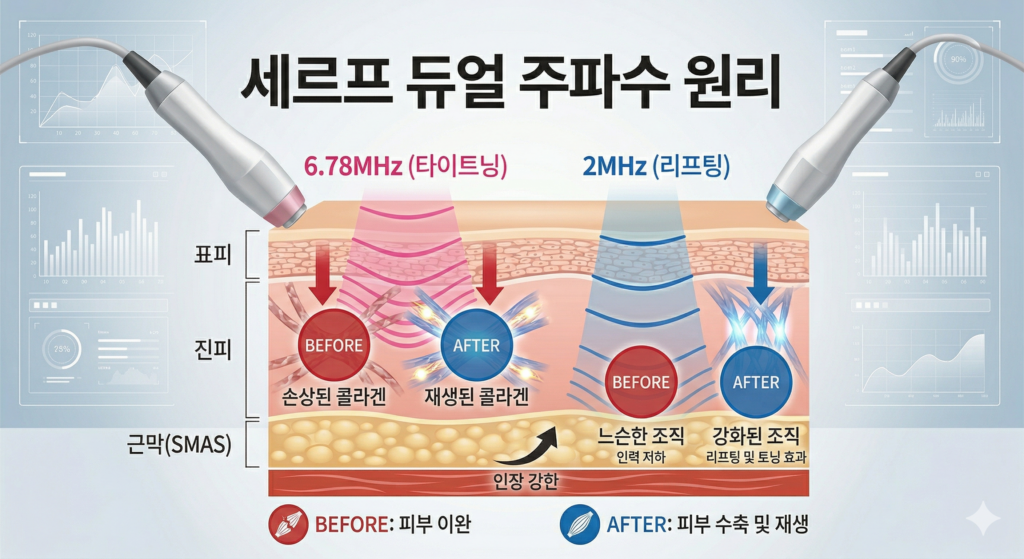
To conclude, the Thumbtack Serf is the world's first dual monopolar RF device that uses two frequencies simultaneously, 6.78 MHz and 2 MHz, to deliver energy to the dermis as well as the subcutaneous fat and fascia layers.
This is important because.
The monopolar high frequency equipment we are familiar with, such as Thermage and Oligio, use a single 6.78 MHz frequency.
This frequency is excellent for delivering heat evenly across the dermal layers to induce collagen remodeling.
In other words, it specializes in “skin tightening on the outside”.
But Serp topped it off with another lower frequency, 2 MHz.
It utilizes the physical principle that the lower the frequency, the deeper the energy penetrates (the depth of penetration is inversely proportional to the square root of the frequency). Reference: Weiss et al, Cureus 2026.
If 6.78 MHz is responsible for the “tightness” of the dermis, then 2 MHz is responsible for the “pull” of the subcutaneous fat layer and fascia layer (SMAS) underneath.
Indeed, in a histologic study by Hong et al. (2024), 6 hours after CERF treatment, shrinkage and thickening of collagen bundles in the dermis, as well as thickening and upward traction of the subcutaneous fat layer's fibrofascia and the fascia layer itself, were noted Reference: Hong et al., Skin Res Technol 2024.
This was not observed with the original 6.78 MHz single instrument.
So here's how I explain it in the clinic.
If Ulthera is “lifting 100“, Thermage is "tightening 100".
What about serfs? Think of them as “100 tightening + 30 lifting”.
While the lifting numbers may seem lower than Ultherapy, the real strength of the Thumbtack Serf is that it can effectively cover areas of nasolabial folds and jowl fat that are difficult to treat with Ultherapy.
[Director Kim Young-kyun's Comment] “I don't think it's fair to characterize the Serp as an ‘upgraded version of the Thermage”. It's more like tightening plus lifting, but it's not a complete replacement for the Ulthera. If your main goal is deep lifting, I'd recommend the Ulthera + Serf combination."
One-line summary: Serf = dual-frequency high-frequency lifting of 6.78 MHz (tightening) + 2 MHz (lifting), enabling energy delivery to deeper layers compared to Thermage.
Is the pain really unbearable without anesthesia?
To be precise, the average pain level during a Thumbtack Serp procedure is NRS 4.2/10, which means that some people fall asleep during the procedure with just an anesthetic ointment.
To be honest, we understand your skepticism: “It's a lifting laser, but it doesn't hurt?”.
Because studies show that the average pain during a Thermage FLX treatment is 6.9/10 on the NRS (and that's after taking pain medication beforehand), and many people report an 8-9 on the Ultherapy scale. Reference: Weiss et al, Cureus 2026.
There are three main reasons why thumbtack serfs can be so low pain.
First, Wave Fit Pulse technology.
Whereas traditional high-frequency equipment delivers energy in one “bang,” Serp breaks up the energy of a single shot into up to 12 subpulses See also: Aestellar - XERF Design.
The idea is that the pain receptors on the surface of the skin are less stimulated because the peak temperature is lower.
Second, the ICD gas cooling system.
Three-stage intelligent cooling automatically adjusts to energy levels.
When you increase energy, you also increase cooling, so you're protecting the epidermis and reducing pain at the same time.
Note that there is also a built-in failsafe that automatically shuts off the RF output if the tip surface temperature exceeds 43°C. Reference: Weiss et al, Cureus 2026.
Third, the tip area is about 1.5 times larger than traditional equipment.
By spreading the same energy over a larger area, the heat burden per unit area is reduced, and therefore the perceived pain is lower.
Here's a real-world example.
A woman in her mid-40s (pseudonym: Seoyeon Lee) has had two Thermage treatments, and each time she had to take a break.
I had a Serp 600 shot with just an anesthetic ointment, and during the procedure, he said, “I feel a warm sensation, but is that it?”.
Of course, pain is an individual thing.
You may feel it a little more in areas that are close to the bone or where the flesh is thin.
That's why at Core Dermatology, we fine-tune the energy levels (10 levels) and cooling stages for each area.
The key is to keep it at the right temperature (40-50°C) long enough to induce collagen synthesis, not necessarily hotter.
[Director Kim Young-kyun's Comment] “Lower serp pain does not necessarily mean weaker energy; in fact, the total energy delivery is greater for the same number of shots due to the 1.5 times larger tip area. The formula of less pain = weaker energy doesn't hold true for serfs.”
One-line summary: Thrush Serp Pain NRS 4.2/10 - Levels tolerable with anesthetic ointment alone, thanks to the triple design of Wave Fit Pulse + ICD cooling + large tip area.
Won't getting a serf cause ball pimples?
The bottom line is that Thumbtack Serf is not a fat cell destroying procedure, so the risk of cheek plaque is low under the right energy settings.
“Cheek bruising” is probably the word that most people who are looking into lifting procedures dread.
“I don't have much weight, won't a lift make my cheeks look sunken in?” - I hear this worry a lot.
To understand this part, you need to know a little more about how thumbtack serfs work.
Devices like HIFU (Ulthera-Shrink, etc.) and Onda contain a mechanism that uses focused energy to partially kill fat cells.
Liposuction works the same way, by reducing the fat cells themselves.
Thumbtack serfs have a different mechanism than these.
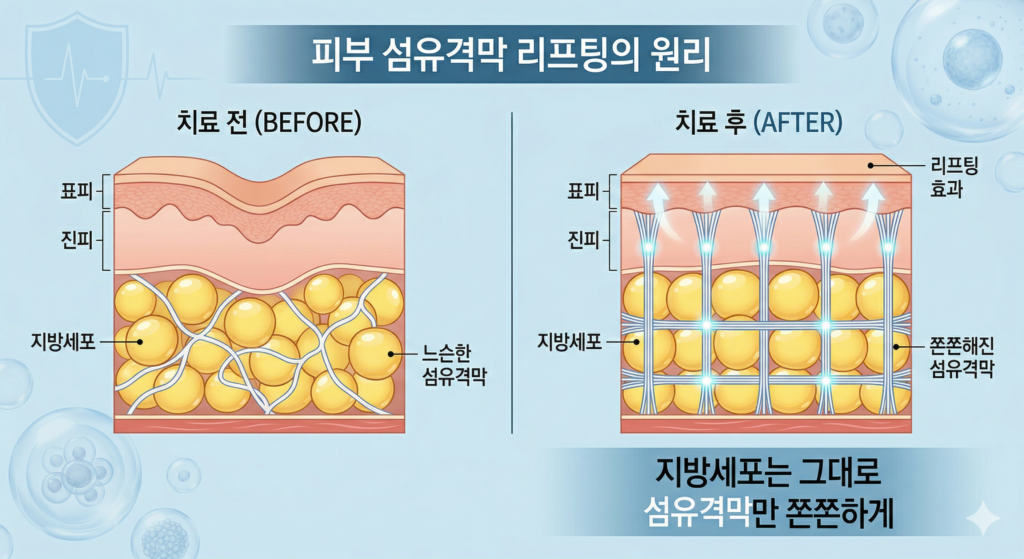
RF energy from CERF shrinks “fibrous septae,” the web-like structures between fat cells. Reference: Hong et al., Skin Res Technol 2024.
It's not that the fat cells are shrinking, it's that the structures surrounding the fat are tightening and contouring.
Here's an analogy.
You're not deflating the balloon, you're pulling the netting that holds it taut.
When the net is tightened, the whole thing is smoothed out, but the balloons (fat cells) themselves are still there.
However, I have to be honest with you.
As with any procedure, reckless irradiation with excessive energy can cause unintentional tissue damage.
Serfs are no exception.
That's why pre-procedure design is so important.
At Core Dermatology, we always look at your face before the procedure, marking areas to focus energy on and areas to avoid.
If you have less cheek fat, you might want to lower the energy level in DEEP mode, or only use MIDDLE mode for those areas.
[Director Kim Young-kyun's Comment] “There's one thing I always tell people who are worried about Serp cheekbones: ‘The machine doesn't cause cheekbones, it's the way the treatment is done, where they push the same settings across the face without site-specific design.” It's safest to find a clinic that designs different depths and energy for different areas."
One-line summary: Thumbtack serpentine = principle of fibrous septum contraction (adipocyte death ✕ fat cell death) → low risk of ball plaque. However, site-specific design is essential.
300 shots vs. 600 shots, how do you choose?
To be precise, if you want both tightening and lifting effects, we recommend at least 600 shots with the MIDDLE + DEEP combination.
“Isn't more shots always better?” - I get this question a lot.
Half right, half wrong.
There's one concept you need to understand first.
That's “warming up”.
Radiofrequency treatments do not raise the skin temperature to a level that can cause collagen denaturation for the first few dozen shots.
In other words, it's a “warm-up period”.
Let's say this warm-up period is roughly 100 shots.
For a 300-shot procedure, the actual number of effective shots is approximately 200.
For a 600-shot procedure, the actual number of effective shots is approximately 500.
The visible difference is 2x, but the effective shot difference is 2.5x.
Often the price isn't exactly double, so 600 shots is often a better bang for the buck.
And there's one more thing that's unique to Apgujeong Serp.
Serfs are instruments that allow you to select three levels of depth: Shallow / Middle / Deep See also: Aestellar - XERF Design.
300 shots is only enough to cover one depth mode.
You can either focus on tightening in MIDDLE mode or lifting in DEEP mode - you have to choose one or the other.
To achieve both tightening (outer skin elasticity) + lifting (jawline and nasolabial folds), you need at least 600 shots: 300 MIDDLE shots + 300 DEEP shots.
Here's a real-world example.
A woman in her late 30s (pseudonym: Jeong Soo Ah) initially received 300 shots because she was in DEEP mode and only focused on her jawline.
She was happy with her jawline, but she said she didn't notice much difference in her cheeks, so we did the MIDDLE + DEEP combination with 600 shots in the second treatment, and that's when she said her whole face was different.
[Director Kim Young-kyun's Comment] “I always say that design is more important than number of shots. At Core Dermatology, we always start with the design of the area before the treatment and then distribute the number of shots accordingly.”
One-line summary: Serp 300 shots = single mode focus, Serp 600 shots = MIDDLE + DEEP combination for simultaneous tightening + lifting.
When will it work and how long will it last?
In a nutshell, immediate tightening is felt immediately after the procedure, collagen remodeling kicks in over 1-3 months, and maintenance averages 6-12 months.
Let's break down the timeline of the thumbtack serpentine effect a bit more specifically.
Immediately after the procedure to 1 week:
As the existing collagen fibers contract with the heat, you'll notice a subtle tightening immediately after the procedure.
However, this period may be accompanied by some erythema or swelling, which usually resolves within a few hours to a few days.
The fact that you can go back to your daily routine immediately without any severe side effects is a big advantage of Apgujeong Serp. Reference: Weiss et al, Cureus 2026.
1 month to 3 months:
This is where it gets really interesting.
This is where the heat-stimulated fibroblasts produce new collagen and elastin, resulting in firmer skin and a more defined jawline.
A multicenter study by Weiss et al. (2026) found that satisfaction actually increased over time, with GAIS improvement rates of 84.61 TP3T at 30 days and 92.31 TP3T at 90 days Reference: Weiss et al, Cureus 2026.
Three to six months:
This is when collagen remodeling peaks.
A lot of people look in the mirror at this point and say, “Oh, this is the best I've ever looked.”.
After 6 months:
Collagen remodeling gradually reaches a plateau, after which the natural aging process resumes.
On average, maintenance treatments are recommended every 6-12 months to keep the results going.
There's one more thing to mention.
Korea's changing seasons, especially the yellow dust and dry air in the spring and the strong UV rays in the summer, accelerate the breakdown of collagen.
After the procedure, be sure to apply sunscreen and moisturize thoroughly, as this will make a big difference in how long the results last.
We recommend avoiding excessive heat exposure, such as saunas and steam rooms, for two weeks after your procedure.
[Director Kim Young-kyun's Comment] “Patients often ask me, ‘When will the results wear off?’ It's actually more realistic to think of it as a maintenance treatment cycle than a ‘when will it wear off‘. Collagen doesn't just disappear once it's made, it's metabolized gradually, so if you keep up with it every six months to a year, you'll end up with a much better baseline than you started with.”
One-line summary: Thumbtack Serf Effect Timeline - Immediate tightening immediately → 1 to 3 months collagen remodeling in full swing (GAIS improvement rate 92.3%) → 6 to 12 months maintenance.
What are 3 things to look for when receiving an Apgujeong Serp?
To summarize, there are three things you should look for: 1) a dermatologist who performs the procedure himself, 2) competence in designing site-specific designs, and 3) sufficient experience in performing serfs.
If you search for tumescent radiofrequency lifting, you'll find tons of clinics.
With all the different prices and claims of excellence, it's hard to know what to look for.
Here are three criteria I've learned over 15 years of practicing dermatology.
First, make sure your dermatologist is performing the procedure.
The Thumbtack Serp is a piece of equipment that requires a combination of 3 depths (Shallow / Middle / Deep) and 10 energy levels See also: Aestellar - XERF Design.
The thickness, amount of fat, and amount of sagging skin varies from person to person, and even from area to area within the same face.
To make this judgment in real time and change settings, an expert understanding of skin structure is essential.
Second, ask if they do site-specific design before the procedure.
As we mentioned in the ballframing section, the tack serp is all about “where, how deep, and how much”.
The same 600 shots will produce completely different results than shooting uniformly across the face with no design, and distributing the shots by areas to avoid and focus on.
At Core Dermatology, we always check the areas of concern in person, mark the areas of focus and avoidance, and design a depth, energy, and shot allocation chart for each area before starting the treatment.
Third, check your cumulative experience with serf procedures.
The Apgujeong Serp is a relatively new device that became widely available in 2024.
With the addition of the new variable of depth adjustment, your experience with different face types will directly affect the quality of your results.
Even with good equipment, it's hard to find the optimal settings if you're inexperienced.
[Director Kim Young-kyun's Comment] “When I first started with Serf, I had a different approach than Thermage-Olizio, so I had to build up enough cases to create an optimal protocol. Now I have a lot of know-how in setting up for each area and skin type, and now that I'm in the double digits, I can say, ‘I'm confident.”
One-line summary: Criteria for choosing a tumescent serp hospital = expert hands-on + site-specific design + sufficient experience with serp procedures.
Thumbtack Serf FAQ
If you're considering a presser foot serpentine lift, be sure to have a one-on-one consultation with a dermatologist before the procedure to fully discuss your skin condition, sagging, and expectations.
At Core Dermatology, Dr. Kim Young-gyun, a dermatologist with 15 years of experience, personally guides you from consultation to design, treatment, and aftercare. The most important aspect is to design the depth, energy, and number of shots according to each customer's facial structure and concerns.
Don't just go with the lowest price based on reviews and don't just go with the lowest price based on reviews - make sure you're going with someone who can design a face lift that fits your face.
Thank you for reading the long text.
Sincerely, Kim Young-gyun, Chief Director of Core Dermatology
⚠️ This content is for medical information purposes only and does not guarantee the effectiveness of any specific procedure. Results may vary depending on the individual's skin condition, age, lifestyle, etc. and should be determined after full consultation with a dermatologist. This article was written in compliance with Article 56 of the Medical Act and the Enforcement Decree of the same Act.
📚 References
- Weiss et al. - Clinical Outcomes Following Dual-Frequency NMRF Treatment, Cureus 2026;18(3):e104546
- Hong et al. - Efficacy of dual-frequency noninvasive monopolar RF: Histological evidence, Skin Res Technol 2024;30(6):e13821
- Aestellar - Monopolar RF program designing on XERF for facial contouring
- Radium Medical Aesthetics - XERF vs HIFU Skin Tightening Treatment
- Flawless MedSpa - XERF Skin Tightening
- XERF Official Site


 한국어
한국어  English
  日本語
日本語  简体中文
简体中文